
Staff Augmentation and AI: Redefining Your Team Structure
TL;DR: Staff augmentation in 2026 is not the old model of temporary headcount to fill gaps. It is a deliberate strategy for combining human expertise with AI capability — building teams that are more capable, more flexible, and more efficient than either humans or AI alone. The organisations getting this right are not asking "how many people do we need?" They are asking "what is the right mix of people, AI, and external expertise for this outcome?"

Introduction
There is a familiar tension in every growing business. You have more work than you have people. Hiring takes time, costs real money, and carries the risk of bringing in the wrong person at the wrong moment. Contractors fill gaps but come and go. And now, layered on top of all of that, there is AI — which changes the equation entirely.
The old model of staff augmentation was relatively straightforward. You identified a skill gap, you brought in a contractor or a consultant to fill it, and you kept the team lean in between. It was an operational patch.
In 2026, that model no longer works — not because it is wrong, but because it is incomplete. The question is no longer just "who do we need to hire or contract?" It is "what combination of people, AI systems, and external expertise produces the best outcome for this specific body of work?"
This article is a practical guide to answering that question.
What staff augmentation really means in an AI-first organisation
Staff augmentation used to mean one thing: borrowing talent. You had a project, you were short on capacity, so you brought in developers, designers, or project managers through an external partner.
In an AI-first organisation, the definition expands. Staff augmentation becomes the deliberate combination of three resources:
Core team members — your permanent employees who hold institutional knowledge, own decisions, and shape the culture.
Augmented talent — external professionals brought in through a trusted partner, integrated into your workflows, working alongside your team. They bring specific expertise without the overhead and long-term commitment of permanent hiring.
AI capability — systems that handle defined tasks autonomously or semi-autonomously, from qualifying leads to triaging support tickets to generating reports. These are not replacements for people. They are multipliers.
The skill in 2026 is not in any one of these categories. It is in knowing how to combine them — and when to shift the balance.
Roles that AI augments vs roles it replaces
The most common question from leadership teams: "Is AI going to replace my people?"
The honest answer: it depends on the role — but the pattern is more predictable than most people assume.

Roles where AI augments heavily:
- Customer support. AI handles triage, answers common questions, and drafts responses. Humans handle complex cases, escalations, and relationship-sensitive situations. The result is faster resolution, not fewer people — the team handles higher volumes without adding headcount.
- Sales operations. AI qualifies leads, enriches CRM data, and generates outreach sequences. Reps focus on conversations, relationships, and complex deals. AI makes every rep more productive.
- Marketing. AI drafts content variations, analyses campaign performance, and identifies trends. Marketers focus on strategy, creative direction, and audience understanding.
- Engineering. AI assists with code generation, documentation, and testing. Engineers focus on architecture, security, and the decisions where context and judgment matter most.
Roles where AI is more likely to absorb the work outright:
- Routine data entry and processing. If the work is structured, repeatable, and low-judgment, AI can handle it end to end.
- Basic report generation. AI can produce standard reports faster and with fewer errors than humans — but humans are still needed to interpret, contextualise, and act on the findings.
- Simple scheduling and coordination. AI agents can manage calendars, send reminders, and handle basic logistics.
The pattern to watch: AI absorbs the routine and amplifies the complex. The most valuable human work — judgment, relationship-building, creative direction, and strategic thinking — becomes more important, not less.
How to identify where human expertise still wins
Not everything should be automated. The skill is knowing where human expertise is still the highest-leverage investment.
Human expertise wins when:
- The decision has significant consequences with no clear pattern to lean on. Strategic calls, crisis responses, and high-stakes negotiations require judgment that AI cannot yet replicate reliably.
- The work depends on deep relationships. Trust is built through human interaction. AI can support relationships — it cannot build them from scratch.
- The context is unique or rapidly changing. AI performs best on stable, well-documented domains. When the landscape is shifting in real time, human intuition and adaptability still lead.
- The output requires accountability. If someone needs to own the decision and justify it to a client, a board, or a regulator, that someone should be a person — not a model.
The framing that works in practice: AI should handle what is predictable and repeatable. Humans should handle what is novel, consequential, or relational. The overlap — where humans use AI to enhance their work — is where most of the value lives.
Designing hybrid human-AI teams
The most effective organisations in 2026 are not building separate "AI teams" and "human teams." They are designing integrated workflows where both contribute.
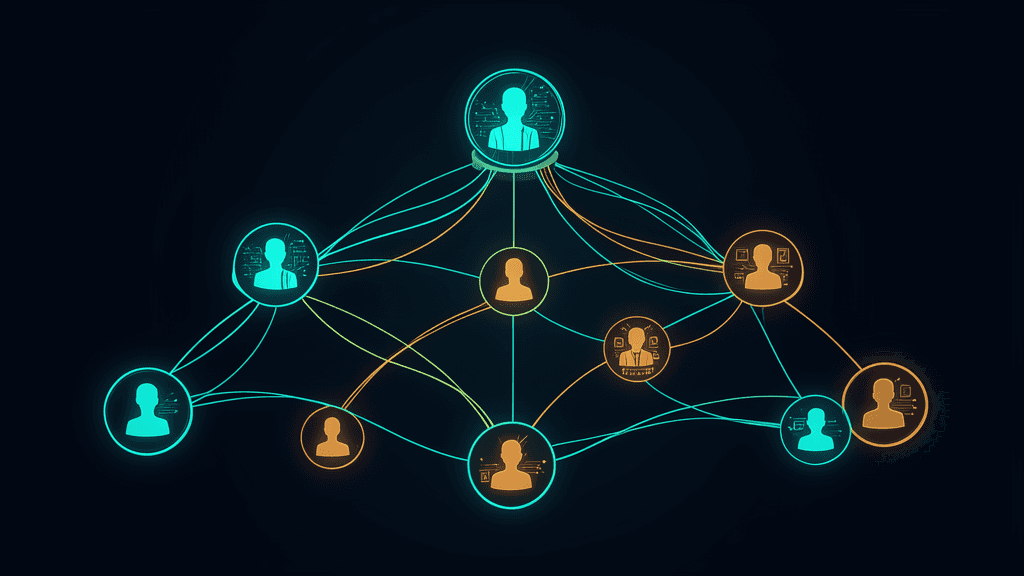
A well-designed hybrid team has four properties:
Clear task boundaries. Everyone — including the AI systems — knows what they are responsible for and where their scope ends. This prevents overlap, confusion, and the "someone else will handle it" problem that kills productivity.
Deliberate handoffs. When AI escalates to a human, the handoff includes full context — what the AI attempted, what it found, and why it escalated. The human does not start from scratch.
Defined ownership. Every outcome has a human owner. AI can execute, recommend, and summarise — but a person is accountable for the result.
Calibrated trust. The team trusts AI enough to rely on it for routine work but sceptically enough to verify outputs that matter. This is not about being "anti-AI." It is about matching scrutiny to consequence.
These properties do not emerge naturally. They require deliberate design — which is why the organisations that invest in team structure, not just tooling, outperform those that treat AI as a plug-and-play productivity upgrade.
Building for flexibility: scale up or down without friction
One of the strongest arguments for the hybrid model is flexibility — the ability to adjust capacity without the lag and disruption of traditional hiring cycles.
Scaling up: When a new project, seasonal demand, or unexpected growth creates pressure, you can bring in augmented talent through a partner while also expanding AI capacity in defined areas. The AI handles the volume spike in routine work. The augmented specialists bring the expertise the core team lacks. Together, they absorb the surge without burning out permanent staff.
Scaling down: When a project ends or demand softens, augmented contracts conclude without the cost and complexity of redundancies. The AI systems remain in place, and the core team continues at normal capacity.
This is not about treating people as disposable. It is about being honest that business demand fluctuates — and building a team structure that can respond without the constant cycle of over-hiring and painful reductions.
The businesses that manage this well treat their augmented partners as a strategic capability, not a contingent expense. They invest in continuity, onboarding, and integration so that when augmented team members arrive, they contribute quickly — and when they leave, the institutional knowledge does not walk out the door with them.
When to hire vs when to augment
Not every gap should be filled by an external partner. Some roles belong permanently inside the organisation.
Hire when:
- The role defines or shapes company strategy
- Institutional knowledge accumulation is essential
- The skillset is core to your competitive advantage
- You need long-term continuity of ownership
- The role involves significant cultural leadership
Augment when:
- You need specific expertise for a defined project or phase
- Speed to capability matters more than permanent ownership
- The skillset is valuable but not core to your long-term differentiation
- You want to validate a role before making a permanent hire
- You need to scale capacity temporarily without the overhead of permanent headcount
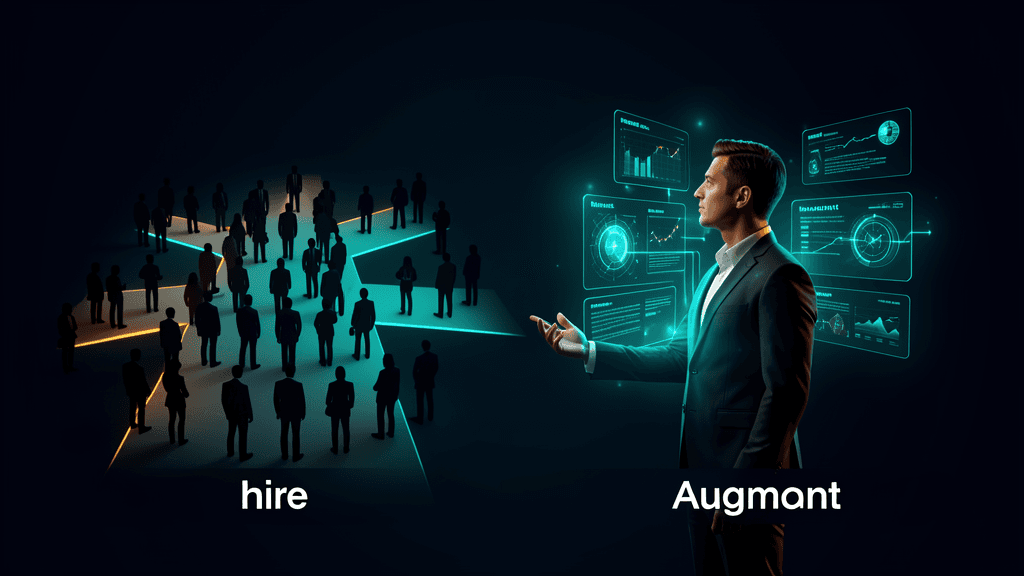
The most common mistake is treating the hire-vs-augment decision as binary or permanent. In practice, many roles start as augmented positions, prove their value, and then convert to permanent hires. Other roles remain augmented indefinitely because the business genuinely needs the flexibility.
FAQs: Staff Augmentation and AI
Does AI reduce the need for staff augmentation?
In some areas, yes — AI can absorb routine work that used to require additional headcount. But AI also creates new needs: system design, prompt engineering, monitoring, and integration work that requires specialised expertise. The net effect is usually a shift in what augmentation looks like, not a reduction in its importance. Businesses still need outside expertise — it is just applied to different problems.
How do we integrate augmented staff with our existing AI tools?
The integration approach should be designed into the engagement from the start. Augmented staff should be onboarded onto your AI tooling as part of their orientation — not treated as an afterthought. The goal is for augmented team members to use the same AI systems the core team uses, contributing to the same workflows and governed by the same standards.
What happens to company culture when part of the team is external?
Culture is not about where someone's contract sits. It is about how people work together. Augmented staff who are embedded in the team, included in relevant communication, and treated as contributors to shared outcomes strengthen culture. Augmented staff who are walled off from the core team create fragmentation. The difference is in how you integrate them, not the employment model.
How do we decide which partner to work with for staff augmentation?
Look for a partner who understands your domain, can provide continuity (not just rotating contractors), and is willing to invest in understanding your systems and workflows. The best augmentation partners behave like an extension of your team — not a supplier filling seats. At Akonita, our staff augmentation model is built around exactly this: embedded professionals who work inside your workflows and contribute to your outcomes.
Are we at risk of over-relying on external expertise?
This is a valid concern. The safeguard is intentional knowledge transfer: augmented staff should document processes, train core team members, and build capability that persists after the engagement ends. A good augmentation partner designs for this from the start — treating every engagement as both delivery and capability building, so the organisation gets stronger over time, not more dependent.
Conclusion
The businesses winning in 2026 are not the ones with the largest teams or the most advanced AI. They are the ones that have figured out how to combine the right people, the right external expertise, and the right AI capability into a structure that can flex without breaking.
This is not a technology decision. It is a team design decision. And it starts with an honest assessment of what your organisation actually needs — not what is trendy, not what everyone else is doing, but what combination of resources produces the best outcomes for the work you actually do.
At Akonita, we help businesses build exactly this kind of structure. Whether you need augmented specialists to accelerate a project, AI systems to handle routine work at scale, or both — our model is designed around embedding the right capability at the right moment, without the overhead and rigidity of traditional hiring.
If you are rethinking your team structure for the AI era, start with a conversation. We will help you figure out what the right mix looks like for your business.