
Build vs Buy: Off-the-Shelf AI or Build Your Own?
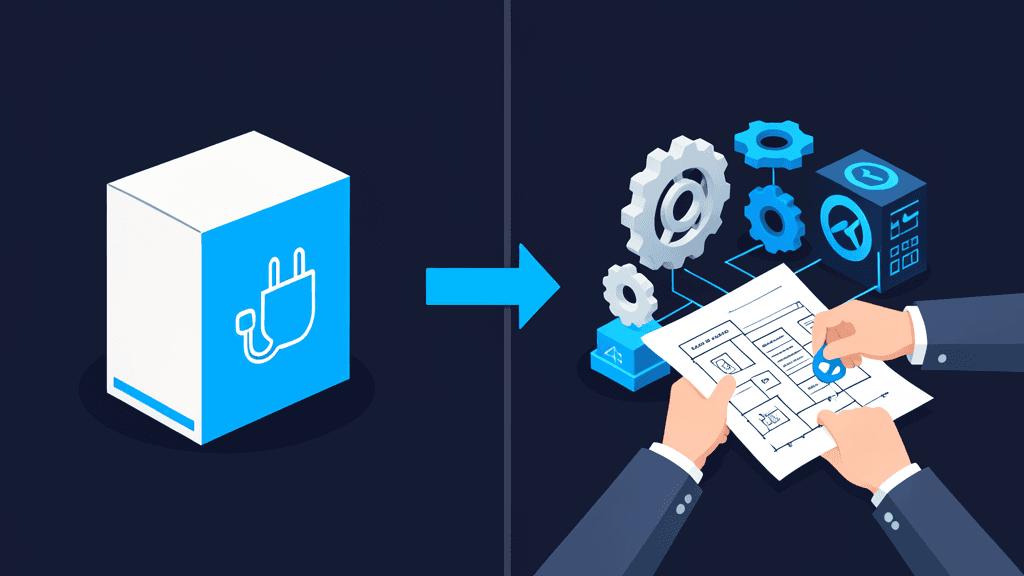
TL;DR: Off-the-shelf AI tools are fast to deploy and good at generic tasks. Custom AI is harder to build but designed around your actual data, workflows, and business logic. The right choice depends on your use case, your data, and how much competitive advantage the solution needs to deliver. Most businesses need both — the skill is knowing which one to use where.
Introduction
Every business evaluating AI eventually hits the same fork in the road.
On one side: a marketplace full of AI tools that promise to solve your problem in minutes, priced per seat, ready to activate today.
On the other side: the option to build something specifically for your business — trained on your data, integrated into your systems, designed around the way your team actually works.
Both paths are real. Both have worked for different organisations. And both have created expensive regrets when chosen for the wrong reasons.
This article gives you a practical framework for making that decision with clarity — not hype.
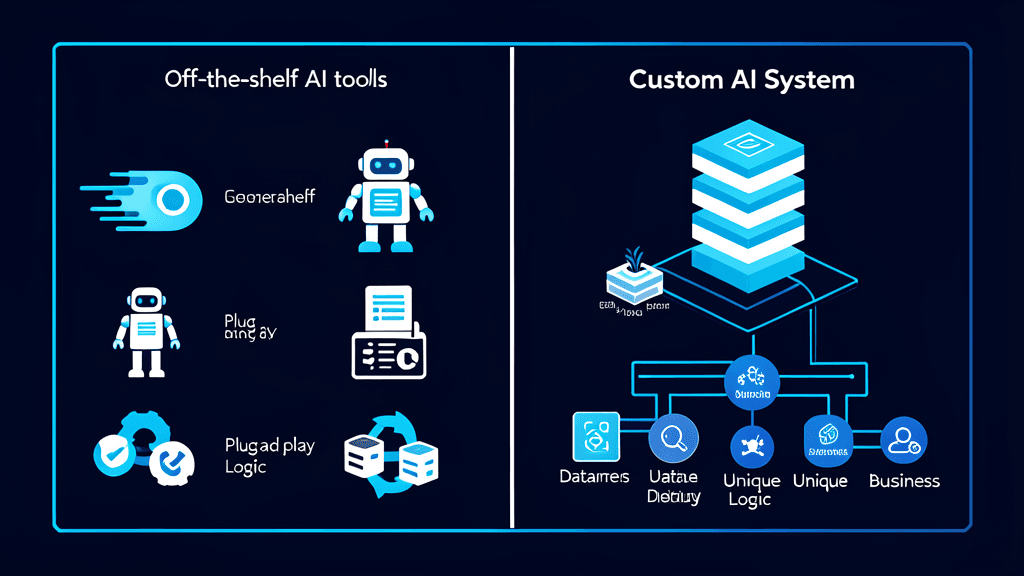
What off-the-shelf AI does well
Pre-built AI tools have improved dramatically. In the right context, they are genuinely powerful.
They work well when:
- The use case is generic. Writing assistance, meeting summaries, document search, and basic customer FAQ tools are well-served by existing products. The problem has already been solved at scale.
- Speed to value matters more than precision. If you need something deployed in days rather than months, a packaged tool removes friction.
- The workflow is not a differentiator. If your email management process does not set you apart from competitors, using the same tool everyone else uses is perfectly fine.
- You want to test before committing. Off-the-shelf tools are useful pilots. They help you understand what a solution would actually look like before investing in a custom build.
- Your team is not technically deep. Many modern AI tools require no engineering — which is an asset if you want adoption without a long IT project.
The best off-the-shelf tools in 2026 are well-designed, well-maintained, and continuously improving. That is a real advantage. You are not just buying software — you are buying a development team you do not have to manage.
Where off-the-shelf hits a ceiling
The limitations show up when you try to make a generic tool do something specific.
Your data stays outside the model. Most packaged AI tools do not learn from your organisation's data in any meaningful way. They process what you give them in the moment, but they do not carry forward the institutional knowledge that makes your business distinctive.
Integration becomes a patchwork. Connecting a third-party AI tool to your CRM, your internal knowledge base, your approval workflows, and your reporting stack is often more complex and fragile than expected. The vendor supports their product. They do not support your ecosystem.
You are limited to the vendor's feature roadmap. If the tool does not do exactly what you need, your options are workarounds or waiting. You cannot change the underlying model or logic.
Sensitive data becomes a risk surface. Many off-the-shelf tools send data to third-party servers. For businesses handling client data, financial information, or proprietary processes, this creates real security and compliance exposure.
The ROI plateau comes quickly. Off-the-shelf tools often deliver fast early wins, then level off. Once you have extracted the generic value, there is nowhere to go without more investment — usually in a custom layer on top of what you already paid for.
What custom AI actually means
Custom AI does not always mean training a model from scratch. In most business cases, it means:
- Fine-tuning or prompting an existing foundation model on your specific data and context
- Building a workflow that connects AI capabilities to your actual systems and approval chains
- Designing logic that reflects how your business actually operates, not a generic average
- Creating observability and monitoring so you can see what the system is doing and why
This is more work than activating a SaaS subscription. But it is also not the multi-year, multi-million-dollar research project it might have been five years ago.
The real investment in custom AI is design time: understanding the use case, defining the data requirements, mapping the workflow, and building the governance layer that makes it trustworthy in production.
When custom makes more sense
Custom is the better choice when:
The use case is a differentiator. If AI could make your customer experience, your sales process, or your operational speed genuinely better than your competitors, that is worth building — not licensing. Competitors can buy the same tools you buy. They cannot easily replicate your proprietary system.
Your data is your edge. Many businesses have years of customer interactions, operational records, and domain expertise sitting in unstructured files. A custom system that learns from that data can do things no off-the-shelf tool can match.
The workflow is complex or regulated. When AI needs to interact with multiple internal systems, follow specific approval rules, or produce outputs that must be auditable, custom architecture gives you the control that packaged tools do not.
You have already hit the off-the-shelf ceiling. If you have tried a generic tool and found that it gets you 70% of the way there but creates friction at the edges, the missing 30% is often where the real value lives — and only a custom solution can reach it.
Security requires data isolation. If your data cannot leave your environment, you need a solution that runs inside your infrastructure. That is almost always a build.
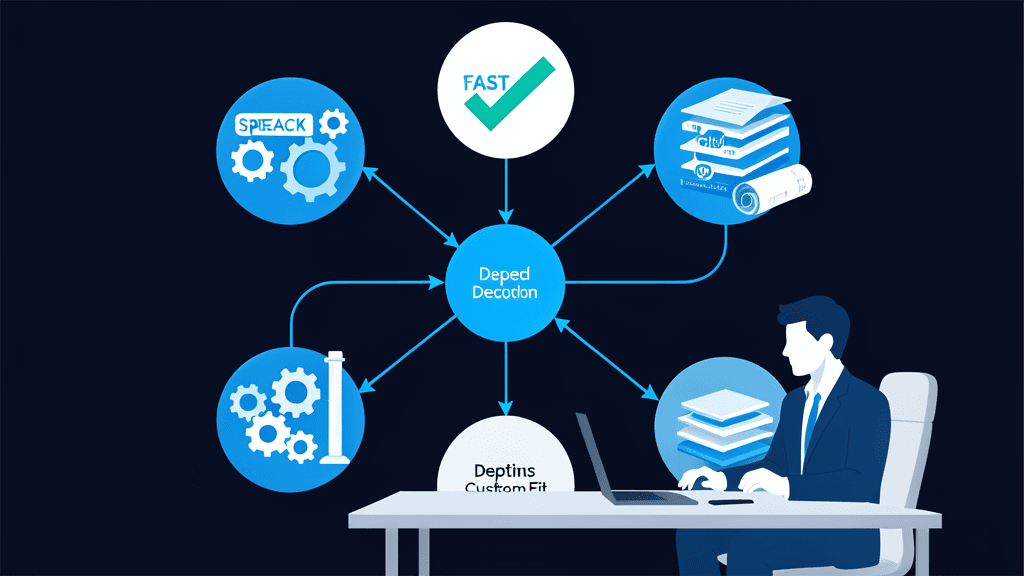
A simple decision framework
Before choosing, answer five questions honestly:
1. Is this use case a competitive differentiator? If yes, custom protects the advantage. If no, off-the-shelf is probably fine.
2. Do we have proprietary data that should inform this system? If yes, custom unlocks that value. If no, a generic model likely performs comparably.
3. How complex is the integration requirement? Simple integrations favour off-the-shelf. Complex, multi-system workflows favour custom.
4. What are our security and compliance constraints? If data must stay internal or under your control, that often forces a build.
5. How quickly do we need this working? If speed is paramount, start with off-the-shelf and plan for a custom phase. If you have runway, design it right from the beginning.
Most businesses find that the honest answers split their AI roadmap into two categories: commodity workflows that off-the-shelf handles well, and strategic workflows that justify a custom approach.
The hidden costs on both sides
Neither option is as straightforward as it looks on the surface.
Off-the-shelf hidden costs:
- Per-seat or usage-based pricing that scales faster than expected
- Integration and configuration work that is never free
- Staff time spent adapting workflows to the tool's limitations
- Vendor lock-in that makes switching expensive later
- Security reviews for every new tool in the stack
Custom hidden costs:
- Discovery and design time before a line of code is written
- Ongoing maintenance, monitoring, and model updates
- Internal knowledge required to manage the system after launch
- Higher upfront investment before value is demonstrated
The comparison is rarely as simple as "custom costs more." In many cases, a well-designed custom system costs less over three years than a stack of off-the-shelf tools that only partially solve the problem.
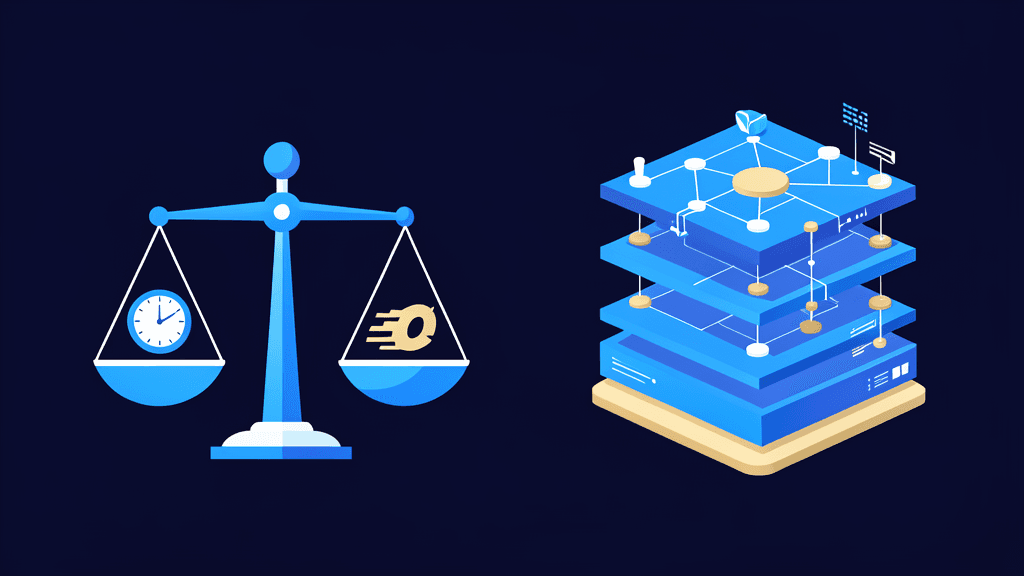
The hybrid approach most businesses end up with
In practice, very few organisations choose entirely one or the other.
The pattern that works:
- Use off-the-shelf for generic, fast-moving, low-risk functions — internal communication support, scheduling assistance, document summarisation, basic Q&A
- Build custom for your core workflows — the processes that directly touch customer experience, revenue generation, or operational efficiency
- Plan the integration layer carefully — the most valuable custom systems are the ones that connect your proprietary data and logic to capable foundation models
This hybrid approach lets you move quickly on low-stakes automation while protecting the investment where it counts.
FAQs: Build vs Buy AI
Is off-the-shelf AI ever good enough for a serious business?
Yes. For many workflows, it is the right choice. The mistake is assuming that off-the-shelf is always the faster or cheaper option — which is not always true once you factor in integration, customisation limits, and long-term costs.
How long does it take to build a custom AI system?
A well-scoped custom AI workflow can be designed, built, and deployed in four to twelve weeks depending on complexity. The bigger variable is usually discovery and data readiness, not the build itself.
What if we start with off-the-shelf and want to move to custom later?
That is a common and sensible path. Off-the-shelf tools help you learn what you actually need before committing to a custom build. The key is to avoid vendor lock-in that makes the transition expensive.
Does custom AI require us to have a large internal tech team?
No. Many businesses work with an external partner to design and build the custom system, then hand over a system that is manageable with a small internal team or through an ongoing support arrangement.
How do we know if our use case justifies a custom build?
If the answer to two or more of the five questions in the framework above points toward custom, it is worth a scoping conversation. The investment is rarely as large as businesses assume — and the ceiling is significantly higher.
Conclusion
The build vs buy question is not a technical question. It is a strategic one.
Off-the-shelf AI is valuable when the problem is generic, the timeline is short, or the workflow does not differentiate your business. Custom AI is valuable when the data, the workflow, or the competitive advantage demands something purpose-built.
Most businesses need both. The skill is knowing which one to apply where — and resisting the pressure to default to one extreme without thinking it through.
At Akonita, we help businesses work through exactly this decision. We assess the use case, the data environment, the integration requirements, and the long-term value to give you a clear recommendation — not a sales pitch for one approach over another.
If you are trying to figure out which path makes sense for your business, start with a conversation.