
Collaborative Intelligence: AI and Humans Working Together

TL;DR: The goal is not to automate humans out of the loop. It's to design systems where AI scale and human judgment produce better results than either could alone.
Introduction
The most common mistake businesses make when adopting AI is framing it as a choice between human and machine.
They ask: Should we use AI, or should we use human expertise?
That is the wrong question.
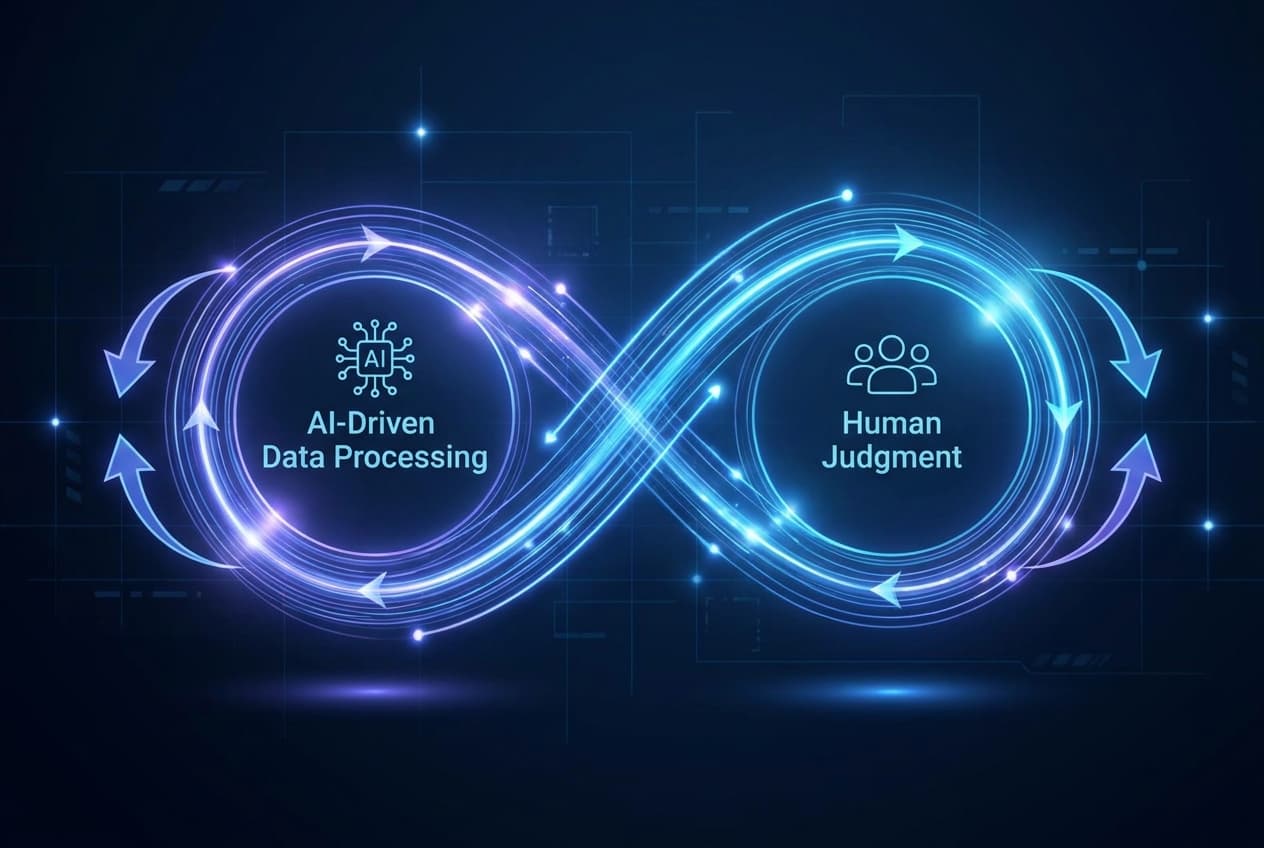
The real strategic advantage sits in the space between — collaborative intelligence. It means designing systems where AI and human expertise work together to produce outcomes that neither could reach on its own.
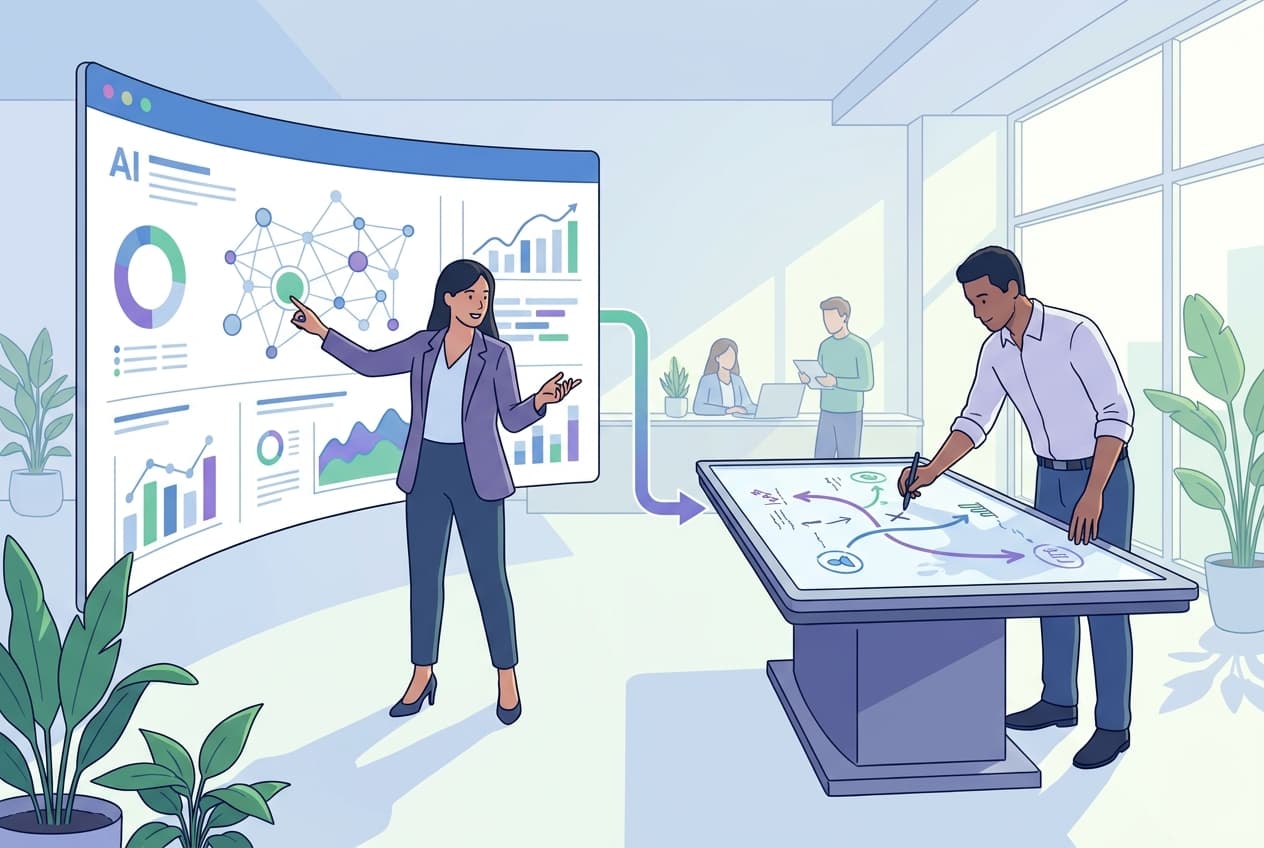
AI is powerful at processing scale, finding patterns, and managing logic. Humans are powerful at exercising judgment, managing nuance, driving strategy, and leading creative direction. When these strengths combine — when AI sharpens human capability instead of replacing it — the business gains a form of operating power that is hard for competitors to match.
At Akonita, we believe this is the future of enterprise operations. It is not about replacing teams with agents. It is about building better decision systems where human judgment sits at the center of the operating model.
Why Partnership Beats Pure Automation
It is tempting to look for 100% automation. It sounds efficient, predictable, and clean.
But in real-world business environments, 100% automation is rarely the right goal.
Real business involves edge cases, shifting priorities, evolving customer needs, and subtle context. Rigid automation struggles in that environment.
Partnership, however, thrives in it.
Collaborative intelligence works better because:
- AI handles the volume: It processes the scale, organises information, and manages routine logic.
- Humans handle the value: They apply judgment to the final decisions, drive innovation, and build the relationships that scale.
The result is a system that feels both efficient and responsive.
The Pillars of Human-AI Collaboration
Building effective human-AI collaboration requires more than installing an AI tool. It requires deliberate design of how humans and AI interact.
1) Human-in-the-loop (HITL) workflows
The most effective AI systems are built with human checkpoints where they are needed most. This isn't just about review — it's about making sure the AI and the human each have the information they need to contribute their respective strengths.
2) Decision support, not decision replacement
Use AI to surface signals, prepare information, and recommend paths forward. Keep human stakeholders in the driver's seat for strategic decisions, high-impact communications, and ethical judgment.
3) Loop-back learning
The best AI systems get smarter because people are involved. Every time a human interacts with an AI-driven workflow — by overriding an action, correcting an insight, or providing new context — the system learns and improves.
4) Shared context and visibility
Collaboration requires a shared view. When both the AI and the human can access the same operational data, requirements, and logs, the quality of their interaction increases significantly.
Where Collaborative Intelligence Creates Value
The practical applications of human-machine collaboration are widespread.
Strategy and planning
AI agents can analyse market patterns and competitor signals, while humans use those insights to shape business strategy, roadmap priorities, and competitive positioning.
Customer service and engagement
AI can manage initial triage, resolution of common queries, and lead qualification, leaving human agents to focus on complex, high-value customer interactions.
Product development
AI can synthesise user feedback, surface feature requests, and draft documentation, allowing product teams to focus on design decisions and long-term vision.
Internal operations
AI can automate routine data entry, reporting, and policy monitoring, freeing up employees to focus on improvement, change management, and team leadership.
How Agentic AI Elevates Collaboration
Agentic AI changes the nature of the partnership.
In more basic AI setups, the human is often limited to reviewing an output generated by a static model.
With Agentic AI, the human is part of a dynamic workflow. The agent can monitor the environment, use tools to perform tasks, ask for human help when it reaches its boundaries, and report back once the action is complete.
This creates a high-trust workflow where:
- The human defines the objective and the boundaries
- The agent takes responsibility for executing steps within those boundaries
- The human steps in to provide judgment when the context becomes nuanced
- The agent provides clear visibility into what it has done and why
Designing for Collaboration
Designing for collaboration means asking different questions during the build.
Instead of asking "What can we automate?", ask:
- Where do our humans currently spend their time on low-value sorting?
- Where is human judgment most needed but currently struggling to get enough context?
- How can we make the human-AI handoff more seamless?
- What data does the human need to trust the AI's recommendation?
- How does the system learn from human intervention?
These questions shift the focus from replacing humans to strengthening them.
FAQs About Collaborative Intelligence
What is collaborative intelligence?
Collaborative intelligence is the operating advantage created when humans and AI work together — combining AI's scale and speed with human judgment and creativity to achieve better outcomes than either could alone.
Is this about replacing people?
No. The goal of collaborative intelligence is to strengthen human capability. It offloads routine, high-volume tasks so that people can focus on higher-value activities that require human nuance.
How do humans work with Agentic AI?
In a collaborative system, humans act as architects of the workflow — setting goals and boundaries, and stepping in to provide strategic direction or final approval at key decision points.
What is the biggest advantage of human-AI collaboration?
The biggest advantage is operational capability at scale. It combines the speed of automation with the flexibility and judgment of human experience, creating a system that is both efficient and smart.
How can businesses start building this?
Start by identifying bottlenecks where human judgment is needed but starved of data, or where high-volume manual tasks are slowing down high-value work. Design AI-driven workflows to bridge those specific gaps.
Conclusion
The future of work is not AI versus human.
It is human plus AI.
The businesses that succeed will be the ones that build the best partnerships — creating systems where machines handle the scale and people handle the direction.
At Akonita, we help businesses design Agentic AI systems built for this kind of collaboration. We focus on building workflows that sharpen human capability, improve decision-making, and create a stronger foundation for growth. Because the most effective business strategy is not just about adopting the best technology. It is about equipping your people to do their best work.
If you want to design a collaborative AI workflow for your team, talk to us here: https://akonita.com/contact.