
AI Change Management: Getting Your Team to Actually Use It

TL;DR: Most AI rollouts fail not because the technology does not work, but because the people do not use it. Closing the adoption gap requires a deliberate change management strategy — building internal champions, running structured onboarding, measuring real usage, and giving managers a clear role in making AI part of how work actually happens.
Introduction
A business invests in an AI tool. The demo is impressive. The vendor promises productivity gains. The project team gets access. Three months later, half the licences are sitting unused and the people who were supposed to benefit have quietly gone back to doing things the old way.
This is not a rare story. It is the default outcome when AI adoption is treated as a technology project rather than a people project.
The technology is rarely the problem. The promise of a well-built AI tool is usually real. The gap that kills most rollouts is the distance between access and actual, habitual use — and that gap is a change management problem.
This article is a practical guide for closing it.
Why AI tools get ignored after launch
Before building a fix, it is worth understanding why the problem happens in the first place.
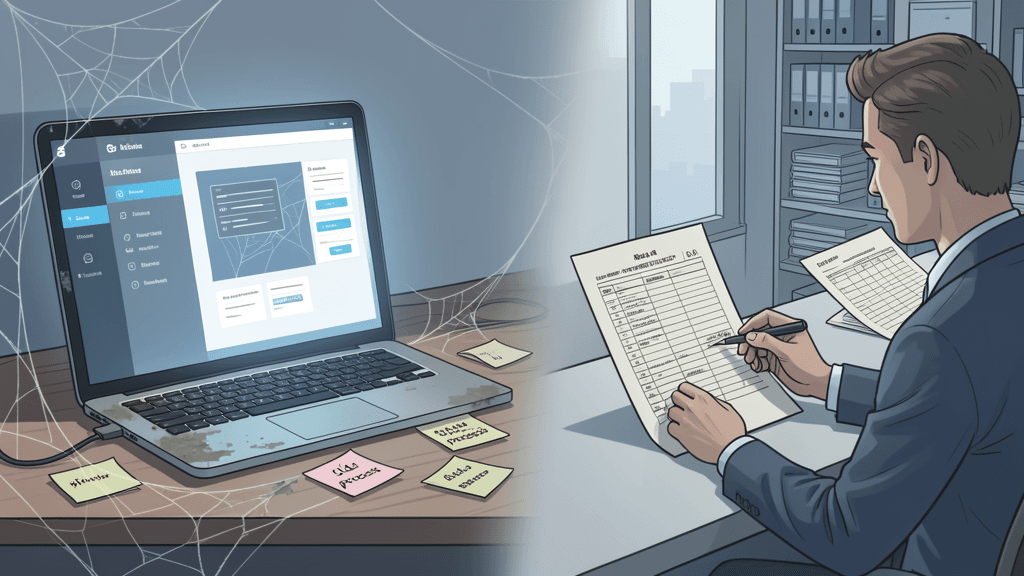
The tool does not fit the actual workflow. Many AI tools are deployed against a use case that is slightly different from how people actually do their work. The result is friction — an extra step, an unfamiliar interface, an output format that still requires manual clean-up. Small friction compounds quickly, and people stop bothering.
Nobody explained the "why" clearly. People default to what they know. If the business case for change was not communicated in terms that matter to the individual — time saved, frustration reduced, quality improved — adoption is optional in practice, even if it is mandatory in policy.
Training was a one-off event. A single onboarding session rarely creates lasting behaviour change. People need to encounter the tool repeatedly in the context of real work before it becomes second nature. One hour of demos does not do that.
There is no visible endorsement from managers. Teams take cues from the people they report to. If a manager is not visibly using the tool and actively encouraging the team to do the same, the implicit signal is that it is optional or low-priority.
The tool is perceived as a threat. In some teams, AI tools land in an environment where people are worried about their roles. No amount of good product design overcomes that if it is not addressed directly.
Understanding which of these factors is at play in your organisation shapes which interventions actually work.
Change readiness before technical readiness
There is a common tendency to evaluate AI readiness purely in technical terms — data quality, integration capability, infrastructure maturity. Those things matter, but they do not predict adoption.
A separate, more honest question is: how change-ready is this organisation?
Useful signals to assess before deploying a new AI tool:
- Recent change track record. Has the team successfully adopted new tools or processes in the last 12 months? If previous rollouts stalled, the issue is systemic — and the same friction will repeat.
- Psychological safety. Do people feel comfortable admitting confusion or asking for help? If not, low-quality adoption (nodding along, clicking through, reverting privately) is likely.
- Workload at time of launch. Asking an already overstretched team to learn a new tool is asking for exactly the resistance you want to avoid. Timing matters.
- Clarity of ownership. Does someone own the adoption outcome — not just the deployment, but actual sustained usage? Orphaned tools do not get used.
If the honest assessment is that change readiness is low, address that first. The best AI tool in the world will not move a team that has not been prepared for the shift.
Building internal champions
The single highest-leverage investment in AI adoption is identifying and developing internal champions.
Champions are not power users or early adopters by accident — they are people who understand the tool deeply, can translate it into the language of their team's specific work, and are trusted enough that their endorsement changes behaviour.

How to find them:
Champions tend to surface early if you watch for them. They ask good questions during onboarding. They explore features independently. They are already thinking about how the tool fits their actual work rather than just the prescribed use case. They are also the people colleagues come to when they have a problem to solve.
How to develop them:
Give champions deeper access — more context on the tool's capabilities, direct lines to the vendor or implementation partner, and time to experiment. Ask them to document what they learn. Pair them with specific team members to run informal "working sessions" where the tool is applied to a real task together, not just demonstrated.
Why this works:
Peer-to-peer influence is far more durable than top-down instruction. A colleague who shows you how an AI tool saved them two hours on a task you also do regularly is more compelling than any executive communication about digital transformation.
One capable champion per team is a meaningful force multiplier. Three is a movement.
Training and onboarding that actually works
Standard onboarding for enterprise software does not work well for AI tools. The right model is different.
Teach to the task, not the tool. Train people on how to use the AI to complete a specific piece of work they already do — not on a generic tour of all the features. The first session should end with someone having completed a real work task using the tool.
Run short, repeated sessions instead of one long one. Three 30-minute sessions spread over two weeks outperform a single three-hour training every time. Each session should focus on a narrow use case with real examples from the team's own work.
Normalise imperfect use. People hesitate to use AI tools when they feel they need to get it "right". Actively demonstrate rough, iterative use — bad first outputs, refinement, trial and error. Showing the messy middle is more reassuring than showing polished outcomes.
Create a space to ask stupid questions. This can be a Slack channel, a weekly drop-in session, or just a designated person to ping. The goal is removing the activation energy required to get unstuck. If someone has to wait for formal support to resolve a small confusion, they will not wait — they will stop using the tool.
The manager's role in making AI stick
This is the variable most organisations underestimate.
Managers do not need to be technical experts in the AI tool. But they do need to actively integrate it into how the team works — not as an add-on, but as a normal part of how work gets done.
What effective manager behaviour looks like:
- Referencing the tool in team meetings when discussing work in progress ("Have you run that through the summariser before the brief?")
- Incorporating AI-assisted outputs into standard review workflows so the tool becomes a natural step rather than an optional extra
- Asking about adoption in one-on-ones — not to police usage, but to understand what friction still exists and help remove it
- Publicly acknowledging when the tool produced a good outcome ("That prospecting list was really clean — was that from the AI qualification pass?")
None of this requires technical depth. It requires intent. And it signals to the team that AI adoption is part of how work is evaluated here, not a side experiment.
Measuring adoption — not access
The metric most organisations track is licence provisioning or initial login rates. Neither of those tells you whether the tool is actually embedded.
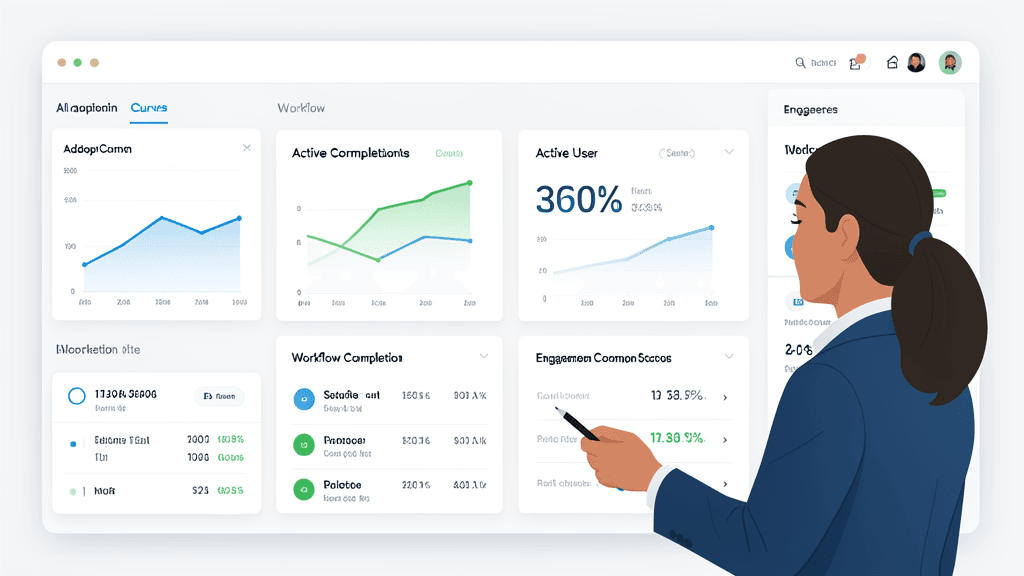
Useful adoption signals to track:
| Signal | What it tells you |
|---|---|
| Weekly active users (as % of total) | Whether usage is sustained or has stalled after launch |
| Average tasks completed per active user | Whether people are using the tool for meaningful work, not just testing |
| Feature engagement breadth | Whether users are discovering value beyond the first use case |
| Qualitative survey (monthly) | Whether people feel the tool is saving time or improving quality |
| Champion-led session attendance | Whether peer learning is happening |
The goal is not 100% utilisation — some roles will have limited use cases. The goal is confident, habitual use among the people for whom the tool was deployed.
Track usage against baseline expectations at 30, 60, and 90 days. If adoption is below target at 30 days, the problem is almost always onboarding or workflow fit — fix it before the pattern sets.
Addressing the fear of replacement
This is not always present, but when it is, it needs to be addressed directly.
The framing that works is not "AI will not replace you." That is an unconvincing promise no one can fully keep. The framing that actually lands is: "Here is what changes about your role, and here is what stays the same — and here is what gets better."
Concrete, honest, role-level clarity about what AI is being asked to do and why reduces anxiety more reliably than reassurance. People are not afraid of AI in the abstract. They are afraid of uncertainty about their own situation.
If AI is genuinely automating parts of a role, be honest about it and be specific about what the role evolves toward. That conversation, handled directly, preserves far more trust than vague reassurance.
FAQs: AI Change Management
How long does AI adoption actually take?
Most organisations see meaningful, sustained adoption within 60–90 days if the change management process is active. Without deliberate management, tools can sit underused indefinitely.
What if senior leaders are not using the tools themselves?
This is a significant barrier. If leadership visible adoption is low, it needs to be addressed at the executive level before broader rollout — the signal it sends overrides most other adoption levers.
Should AI adoption be mandatory or voluntary?
In most cases, making a tool mandatory in policy while leaving adoption optional in practice produces the worst outcome — compliance theatre without real value. A better approach is making adoption the path of least resistance for real work tasks, rather than enforcing it through policy.
How do we handle employees who actively resist?
Start by understanding the underlying concern. Resistance often comes from a legitimate place: fear, unclear expectations, or genuine friction with the tool. Address the root cause. For persistent resistance after honest engagement, the conversation becomes about whether the role fits the organisation's direction — but most resistance resolves with better communication and support.
What is the most common mistake in AI change management?
Treating launch as completion. The project does not end when people get access — it ends when habitual, confident use is established. Most organisations stop investing in adoption too early.
Conclusion
The technology is not the hard part.
The companies extracting real value from AI in 2026 are not the ones with the most sophisticated tools. They are the ones that invested as seriously in adoption as they did in deployment — building champions, designing training around real work, giving managers an active role, and measuring actual usage rather than licence counts.
AI is a capability multiplier. But a capability that sits unused is not a multiplier. It is a sunk cost.
At Akonita, we work with businesses through the full AI adoption lifecycle — from scoping and implementation through to the change management and ongoing optimisation that makes the investment stick.
If your team has the tools but not the adoption, let us help you close the gap.