
AI Readiness Audit: Is Your Business Ready for Agentic AI?
TL;DR: The companies that get real value from AI are not the ones that rush in first. They are the ones that know which workflows are worth automating, what data they can trust, where humans need to stay in control, and how to measure success without fooling themselves.
Introduction
Most businesses are not short of AI ideas.
They are short on certainty.
Leaders know the promise is real, but the practical questions are harder: Is the workflow clear enough? Is the data reliable enough? Who owns the process? Where should AI help, and where should a person still make the call?
That is why the right question is not “Should we do AI?” The better question is:
Are we ready to do AI well?
An AI readiness audit gives you a calm, structured way to answer that question. It helps you see whether your organisation has the foundations to adopt agentic AI in a way that is useful, secure, and measurable.
At Akonita, we see the same pattern repeatedly. Teams want the upside of automation, but they have not yet defined the operating model around it. The result is predictable: scattered experiments, unclear ownership, and pilots that never become production systems.
A readiness audit changes the conversation. It turns AI from a vague ambition into a practical decision.
What AI readiness actually means
AI readiness is not about whether your team has heard of ChatGPT.
It is about whether your business can support an AI workflow in the real world.
A ready organisation usually has:
- A clear use case tied to a business outcome
- Data that is accessible and reasonably trustworthy
- A workflow that is already understood
- Ownership for the process, not just the model
- Guardrails for security, privacy, and approvals
- A way to measure value after launch
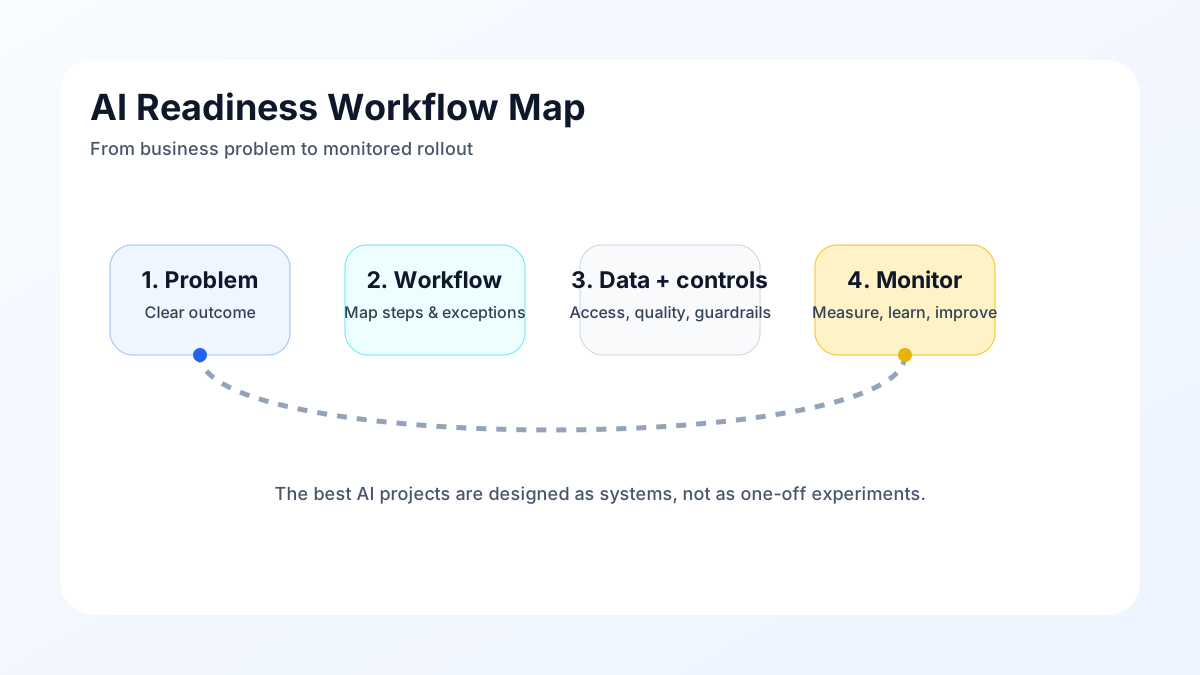
If those pieces are missing, AI adoption becomes expensive guesswork. If they are in place, AI becomes much easier to pilot, learn from, and scale.
The five questions that matter most
A good audit starts with a small set of honest questions. You do not need perfect answers. You just need clear ones.
1) Do we know the business problem we are solving?
This sounds obvious, but it is where many AI projects drift.
A useful AI initiative starts with a real operational problem, such as:
- Support teams spending too long triaging repetitive requests
- Sales teams wasting time qualifying poor-fit leads
- Product teams struggling to synthesise feedback
- Operations teams repeating the same reporting work every week
- Leaders making decisions without enough context in time
If the business problem is not clear, the AI solution will not be clear either.
2) Is the workflow stable enough to automate or assist?
AI works best when the underlying process is at least partly repeatable.
If a team cannot explain the steps in a workflow, an AI system will struggle to improve it. Before building anything, map the process:
- What starts the workflow?
- What inputs does it need?
- What is considered a good outcome?
- Where do exceptions usually happen?
- When should a human step in?
This matters even more with agentic AI, because the system may take actions across multiple steps. The more autonomy you want, the more clarity you need.
3) Is our data usable and trusted?
AI cannot repair a broken data environment by magic.
If the source data is fragmented, inconsistent, inaccessible, or outdated, the system will inherit those problems.
Ask simple but important questions:
- Do we know where the data lives?
- Is it current enough to trust?
- Are permissions and access controls defined?
- Is the data structured enough for this workflow?
- Are there known gaps or quality issues?
You do not need perfect data. You do need data that is fit for purpose.
4) Do we know where humans must stay in control?
This is where many businesses get it wrong.
AI should not replace judgment in areas where context matters, risk is high, or the cost of a mistake is too large.
A strong readiness audit identifies the handoff points:
- When does AI recommend, and when does it decide?
- What needs human approval before action?
- What should be escalated immediately?
- Which outputs should be reviewed before release?

This is the difference between a useful assistant and an operational liability.
5) Can we measure success in business terms?
If the only metric is “the model works,” the project is too vague.
You need metrics that matter to the business:
- Cycle time reduction
- Deflection rate
- Approval rate
- Accuracy or quality score
- Cost per task
- Revenue impact
- Risk reduction
The best AI projects are not only technically impressive. They are operationally obvious.
A simple readiness scorecard
Use this as a quick internal test.
For each area below, score yourself from 0 to 2:
- 0 = not ready
- 1 = partly ready
- 2 = ready
Areas:
- Business problem clarity
- Workflow definition
- Data quality and access
- Human approval model
- Security and governance
- Measurement and ownership

Interpretation:
- 0–4: Not ready yet. Focus on foundations.
- 5–8: Promising, but still needs structure.
- 9–12: Ready to pilot with discipline.
If your score is low, that is not bad news. It is useful news.
It tells you where to invest before the project gets expensive.
Common signs you are not ready yet
A business is usually not ready for agentic AI when:
- Everyone wants AI, but nobody owns the workflow
- The problem is described in vague strategic language
- Teams cannot agree on what a good result looks like
- The data lives in too many disconnected places
- Security is discussed after the pilot has already started
- Success is measured only by how “smart” the output looks
- There is no plan for monitoring after launch
These are not just technical issues. They are operating model issues.
What to do if the audit reveals gaps
That is normal.
Most businesses do not need to stop. They need to sequence better.
Start here:
- Pick one narrow use case with clear value
- Map the workflow before touching the model
- Clean up the minimum viable data
- Define approvals and escalation rules
- Set one or two success metrics
- Pilot before scaling
This is the fastest path to a system people actually trust.
Why this matters for agentic AI specifically
Agentic AI is more powerful than a simple chatbot because it can take actions, coordinate steps, and work across tools.
That power is useful — but it also raises the bar.
If you are deploying agentic AI, you need more than good prompts. You need:
- Clear boundaries
- Observability
- Auditability
- Escalation paths
- Versioned workflows
- Operational ownership
That is why readiness matters so much. The more capable the system becomes, the more disciplined the organisation must be.
FAQs About AI Readiness
What is an AI readiness audit?
An AI readiness audit is a structured review of your workflows, data, governance, and measurement model to determine whether your business is ready to adopt AI effectively.
Do we need perfect data before starting?
No. You need data that is good enough for the specific use case. The audit helps you decide whether the current state is sufficient or whether you need cleanup first.
Is this only for large companies?
Not at all. Smaller teams often benefit even more, because they can focus on a narrow use case and move quickly once the foundations are clear.
What is the biggest mistake businesses make?
They jump into tools before defining the workflow, ownership, and success criteria.
How do we start?
Pick one high-value, repeatable workflow and audit it honestly. If you need help, bring in people who can look at the process, the data, and the governance together.
Conclusion
AI adoption should feel strategic, not chaotic.
If your business is ready, a carefully designed AI workflow can save time, improve quality, and free your team for higher-value work.
If your business is not ready yet, that is still a good outcome — because now you know what needs to be fixed first.
That is the point of the audit.
At Akonita, we help businesses assess readiness, design the right workflow, and move from AI curiosity to practical execution.
If you want to run an AI readiness audit for your team, contact us here.