
The Total Cost of AI: How to Budget for a Real Initiative

TL;DR: Most AI budgets account for roughly half of what the initiative will actually cost. The other half lives outside the vendor quote — in data preparation, system integration, team training, ongoing monitoring, and the iteration cycles that separate working systems from abandoned pilots. This article lays out the six real cost categories, the most commonly underestimated expenses, and a framework for building a budget range you can defend to leadership.
Introduction
There is a conversation that plays out the same way in conference rooms across every industry in 2026. A team brings forward an AI proposal with a clear price tag: the tool subscription, the integration fee, maybe a few weeks of consulting. Leadership approves it. Six months later, the budget has doubled and the initiative is being described as "more expensive than we expected."
The problem is not that AI costs more than it should. The problem is that most organisations budget for the visible costs — the line items that show up in a vendor proposal — and treat everything else as an afterthought.
According to industry analysis, 40 to 60 percent of the true cost of an AI initiative falls outside the initial quote. Data preparation, system integration, model tuning, compliance governance, change management, and ongoing monitoring can collectively represent the majority of total expenditure. And those costs do not disappear if you ignore them. They arrive later, unbudgeted, and usually at the worst possible moment.
This article is a practical framework for getting the budget right before you commit. Not a pricing sheet — every organisation's numbers will be different. But the cost categories are consistent, the patterns are predictable, and the mistakes are avoidable.
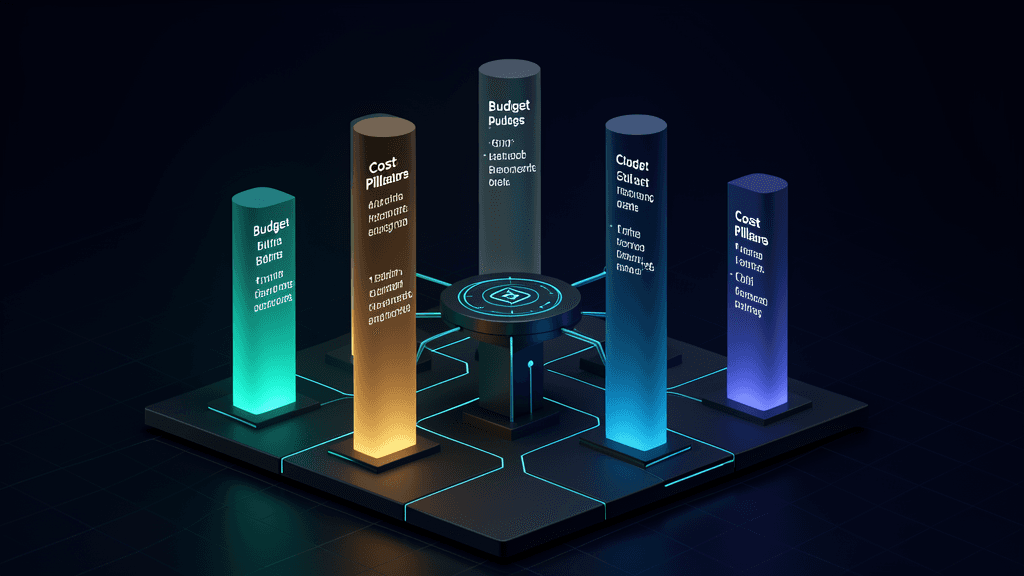
The six real cost categories of an AI initiative
A vendor proposal typically covers one or two of these categories. A real budget covers all six.
1. Development and build. This is what most quotes include: the design, the configuration, the initial build, and the testing required to get the system functioning. Depending on scope and complexity, development costs for a focused AI agent or custom chatbot typically range from $20,000 to $150,000, with enterprise-scale deployments running higher. This is the number most leadership teams anchor on — and the one that understates the full picture.
2. Infrastructure and compute. Cloud hosting, GPU instances, API calls to language models, storage, and networking. These costs scale with usage and are notoriously difficult to predict during the planning phase. Pilot costs are often negligible. Production costs at scale can be an order of magnitude higher. According to IBM's Institute for Business Value, compute costs driven by AI workloads surged 89 percent between 2023 and 2025, and 70 percent of executives identified AI as the primary driver. Budget for infrastructure as a variable cost that increases with adoption — not as a fixed monthly line item.
3. Data preparation and management. Before an AI system can produce reliable outputs, it needs clean, structured, and accessible data. This means standardising formats across departments, resolving inconsistencies in how information is recorded, and building the pipelines that feed the system. Data preparation is routinely the longest pole in the timeline and the most underestimated cost in the budget. It rarely appears in vendor proposals because it is work the organisation must do itself.
4. Integration with existing systems. AI does not operate in isolation. It needs to connect to your CRM, your order management system, your knowledge base, your authentication layer, and your internal tools. Integration work often surfaces poorly documented APIs, outdated databases, and fragile connections that need to be stabilised before AI can function reliably. Industry experience consistently shows integration costs are underestimated by 30 to 50 percent. What is described as a "simple API connection" in a proposal frequently becomes weeks of custom engineering work.
5. Training, adoption, and change management. The technology working is not the same as the team using it. Adoption requires training, documentation, internal champions, and a deliberate change management process. This is an ongoing cost, not a one-time event — team members change, models get updated, and understanding fades without reinforcement. Organisations that treat training as a launch-week checkbox typically see adoption stall within the first quarter.
6. Monitoring, maintenance, and continuous improvement. An AI system in production is a living system. It needs performance monitoring, accuracy checks, regular knowledge base updates, prompt tuning, security reviews, and iteration based on real-world usage data. The ongoing maintenance budget should be 15 to 25 percent of the initial development cost per year — and often more in the first year, when the system is still stabilising.
The costs most organisations underestimate
Some costs are invisible not because they are small, but because they sit in organisational gaps — between departments, between the pilot and the production phase, between the technical build and the human adoption. These are the ones that create the biggest surprises.
Process readiness. AI amplifies whatever workflow it is inserted into. If the underlying process is inconsistent or poorly documented, the AI system produces inconsistent or poor outputs. The work required to standardise processes before AI can function — resolving naming conventions, clarifying ownership, documenting informal workflows — is real work that costs real time. It almost never appears on a budget spreadsheet.
Governance and compliance. Audit trails, human-in-the-loop approvals for critical decisions, data residency requirements, and regulatory documentation are not optional in regulated industries. Adding governance frameworks retroactively, after the system is already built, typically increases the project budget by 20 to 30 percent. Building them in from the start costs less but requires the discipline to treat compliance as a design constraint rather than a post-launch checkbox.
The cost of pilot purgatory. Most AI projects do not meet their initial timeline targets. Each extra month spent in pilot — with a team assigned, infrastructure running, and no production value being delivered — costs $15,000 to $25,000 in direct expenses alone. The opportunity cost of delayed value is harder to quantify but often larger. A project that stretches from eight weeks to sixteen can double or triple the effective cost of the build phase.
The cost of failure. RAND Corporation research found that over 80 percent of AI projects fail to deploy — more than double the failure rate of conventional IT projects. The average sunk cost per failed AI initiative exceeds $150,000. Restart costs typically run 50 to 75 percent of the original budget. And the organisational trust deficit makes future proposals harder to approve, regardless of their merit.
Building a budget range, not a point estimate
The single most effective thing you can do for your AI budget is to stop treating it as a single number and start treating it as a range.
A point estimate — "$80,000 for the build, $12,000 for infrastructure" — creates the illusion of precision. It also creates the conditions for overrun, because every cost that falls outside the estimate becomes an unplanned expense rather than a predicted variance within an acknowledged range.

A practical budget range for a mid-range AI agent — handling multi-step workflows with CRM integration and moderate complexity — looks like this:
| Cost category | Conservative estimate | Realistic range |
|---|---|---|
| Development and build | $50,000 | $50,000 – $90,000 |
| Infrastructure (year 1) | $6,000 | $6,000 – $18,000 |
| Integration | $10,000 | $10,000 – $25,000 |
| Data preparation | $5,000 | $5,000 – $20,000 |
| Training and adoption | $8,000 | $8,000 – $15,000 |
| Governance and compliance | $5,000 | $5,000 – $15,000 |
| Visible subtotal | $84,000 | $84,000 – $183,000 |
| Hidden costs buffer (30–40%) | — | $25,000 – $73,000 |
| True year-one range | — | $109,000 – $256,000 |
The conservative column is what most proposals show. The realistic range is what the initiative will actually cost. The difference is not pessimism — it is the predictable variance that shows up in every initiative when the full scope of work is accounted for.
The practical rule of thumb backed by industry data: multiply any vendor quote by 1.4 to 1.6 to arrive at the true total cost of ownership for year one. That multiplier covers the categories most quotes leave out while giving you a defensible number for leadership review.
Cost versus value: framing the investment for internal approval
A realistic AI budget looks expensive on paper — and it should. The point is not to make the number smaller. The point is to frame it honestly against the value it is expected to produce.
What an AI budget competes against. When leadership evaluates an AI investment, the comparison is rarely "AI versus nothing." It is "AI versus the current cost of doing this work manually." If a support triage system costs $120,000 to build and $30,000 per year to run but replaces $200,000 in annual staffing cost for the same workload, the investment breaks even inside the first year. That is the conversation to have — not whether $120,000 is a lot of money in absolute terms.
Cost per task gives you a denominator. Instead of presenting AI cost as a lump sum, break it down to cost per completed task, per resolved ticket, or per qualified lead. When a $150,000 investment processes 50,000 tasks per year, the unit cost is $3 per task. That number makes the conversation practical and gives you a benchmark to track against over time.
Build in the value of what does not break. Cost avoidance is harder to quantify than cost reduction, but it is real. An AI system that catches compliance errors before they reach a customer, reduces escalation volume by 30 percent, or prevents the need for five new hires as the business scales — these are measurable outcomes even if they do not show up as a line-item saving. Include them in the value case.
When to phase investment versus go all-in
Not every AI initiative needs to be built and deployed in a single phase. In fact, most should not be.

Phase 1: Prove the concept (30 days). Scope a single use case with clear boundaries and measurable outcomes. Budget for the minimum viable build that answers the core question: does this deliver enough value to justify expanding? This phase should be small enough that failure is affordable — a learning investment, not a bet-the-company commitment.
Phase 2: Pilot with real users (60 days). Deploy to a limited group — one team, one channel, one customer segment. Monitor closely. Fix the failure patterns that only emerge with real usage. The data from this phase informs the realistic budget for full production. This is where the cost range narrows from "anywhere between X and Y" to "based on actual usage, Z."
Phase 3: Expand or refine (90 days). Based on pilot data, decide whether to expand the scope, scale the deployment, or pause and refine the approach. The decision at this checkpoint should be driven by measured outcomes, not by sunk cost reasoning. Having spent money on phases one and two is not a reason to continue. Measurable value is.
Go all-in when: the use case is well-understood, the data is clean, the integration surface is stable, the value case is robust, and the organisation has executive sponsorship with realistic expectations. These conditions are rare — which is why phased approaches produce better outcomes for most organisations.
How Akonita approaches engagement pricing
We structure our AI engagements around the same principles we recommend to our clients: transparency, staged commitment, and a clear connection between cost and value.
Scoping comes first. Every engagement starts with a focused scoping phase — typically one to two weeks — that produces a detailed architecture and a realistic budget range, not a point estimate. The scoping phase itself is a fixed-cost commitment. At the end of it, you have enough information to make a real decision about whether and how to proceed.
Build phases are staged. We structure the build around measurable checkpoints, not calendar milestones. Each phase has defined deliverables and defined cost. You are never locked into a multi-phase commitment based on assumptions made during scoping. The data from each phase informs the budget for the next.
Ongoing support is priced for sustainability. Monitoring, maintenance, and continuous improvement are not afterthoughts in our model. They are designed into the engagement from the start, with clear ongoing costs that account for the reality that AI systems need care to stay effective.
This approach is not the cheapest way to build AI. It is the most honest way — and over the life of the engagement, it is typically the least expensive, because it avoids the rework, the budget surprises, and the abandoned pilots that make AI more expensive than it needs to be.
FAQs: Budgeting for an AI Initiative
What is the single biggest budgeting mistake organisations make?
Treating the vendor quote as the budget. The quote covers development. The real budget needs to cover data preparation, integration, infrastructure, training, governance, and ongoing maintenance — categories that collectively represent 40 to 60 percent of total cost. The fix is not to find a cheaper vendor. It is to build a budget that accounts for the full scope of work from the start.
How much should we budget for ongoing costs after year one?
Plan for 15 to 25 percent of the initial development cost per year for maintenance, monitoring, and updates. Infrastructure costs scale with usage, so budget those separately based on projected volume. For a mid-range system with a $80,000 build cost, expect $20,000 to $40,000 in annual operating costs after the deployment year.
Can we start small and expand the budget later?
Yes — and in most cases, you should. A phased approach that proves value at each stage before committing to the next is the most reliable way to control cost and manage risk. The key is to design the phases so that each one produces enough data to inform the budget for the next. A phase-one investment of $30,000 to $50,000 that validates the use case is almost always a better use of capital than a $200,000 commitment based on assumptions.
How do we handle budget conversations with leadership who expect a single number?
Give them a range, not a point estimate. Explain that a point estimate creates the illusion of control and sets the initiative up for being described as "over budget" when predictable costs materialise. Frame the conservative end of the range as the likely minimum, the upper end as the realistic ceiling, and explain what drives the difference. Leadership teams that understand the variance are far more likely to support the initiative through its natural cost fluctuations than teams that were sold an artificially tight number.
What makes AI initiatives more expensive than conventional software projects?
AI systems have characteristics that conventional software does not. They depend on data quality in ways that compound — bad data produces bad outputs, and diagnosing bad outputs takes more work than fixing a software bug. They require ongoing monitoring and tuning because model behaviour shifts as usage patterns change. They introduce governance and compliance requirements that do not exist for deterministic software. And their value is harder to measure upfront, which makes budget conversations more complex. None of this means AI is not worth building. It means AI budgets need to be built differently.
Does building in-house save money compared to working with a partner?
It depends on what you already have. If you have an experienced AI engineering team, clean data infrastructure, and the bandwidth to own the system long-term, in-house can be cost-effective. If you are building those capabilities from scratch while also trying to deliver a working system, the learning curve and the opportunity cost typically exceed the partner premium. The more useful question is not "which costs less on paper" but "which path produces a working, maintained system for the lowest total cost over two years."
Conclusion
The cost of AI is not a mystery. It is predictable — once you know which categories to account for and which patterns to expect.
The organisations that get this right do three things. They budget for all six cost categories, not just the ones the vendor includes. They build a range, not a point estimate, and they defend the range with data. And they phase their investment so that every dollar spent after the initial validation is informed by real usage data, not by assumptions written during the scoping phase.
At Akonita, we help businesses build realistic AI budgets — grounded in the actual scope of the work, structured around measurable checkpoints, and designed to produce systems that keep working long after launch. If you are planning an AI initiative and want a cost estimate you can trust, start with a conversation.
Get a realistic cost estimate for your AI initiative — we will help you figure out what to budget and why.