
How to Effectively Manage AI Project Lifecycles
TL;DR: Most AI projects fail in operations, not in demos. Strong AI project lifecycle management creates clear ownership, production-ready workflows, measurable outcomes, and disciplined iteration from strategy to scale.
Introduction
AI projects rarely fail because the model is not impressive enough.
They fail because the lifecycle around the model is weak.
A use case gets approved. A prototype looks promising. Early momentum builds. Then the real pressure arrives. Data quality issues surface. Ownership gets blurred. Teams lose alignment. Adoption stalls. Costs rise. Trust drops.
This is what happens when businesses treat AI like an experiment instead of an operating capability.
That is why AI project lifecycle management matters.
If AI is expected to deliver real business value, it needs more than technical implementation. It needs clear business ownership, disciplined workflow design, strong governance, measurable success criteria, and a structure that carries the project from strategy through deployment, monitoring, and continuous optimisation.
At Akonita, we see this most clearly in Agentic AI environments. The more capable the system becomes, the more important lifecycle discipline becomes. AI does not just need to work. It needs to be managed properly from start to finish.
Why AI Projects Lose Momentum
Most businesses do not struggle to generate AI ideas.
They struggle to manage those ideas through the full delivery lifecycle.
This usually happens when:
- The use case is not tied tightly enough to a business outcome
- Teams choose models before defining the workflow
- Data readiness is assumed rather than tested
- Ownership is spread too thinly across teams
- Governance is added too late
- Success metrics are vague
- Post-launch monitoring is weak or missing
These issues often stay hidden during early pilot excitement. They become obvious when the project moves toward production.
That is why lifecycle management matters. It gives AI projects the structure they need to avoid drift, stall, and rework.
A Practical AI Project Lifecycle Framework
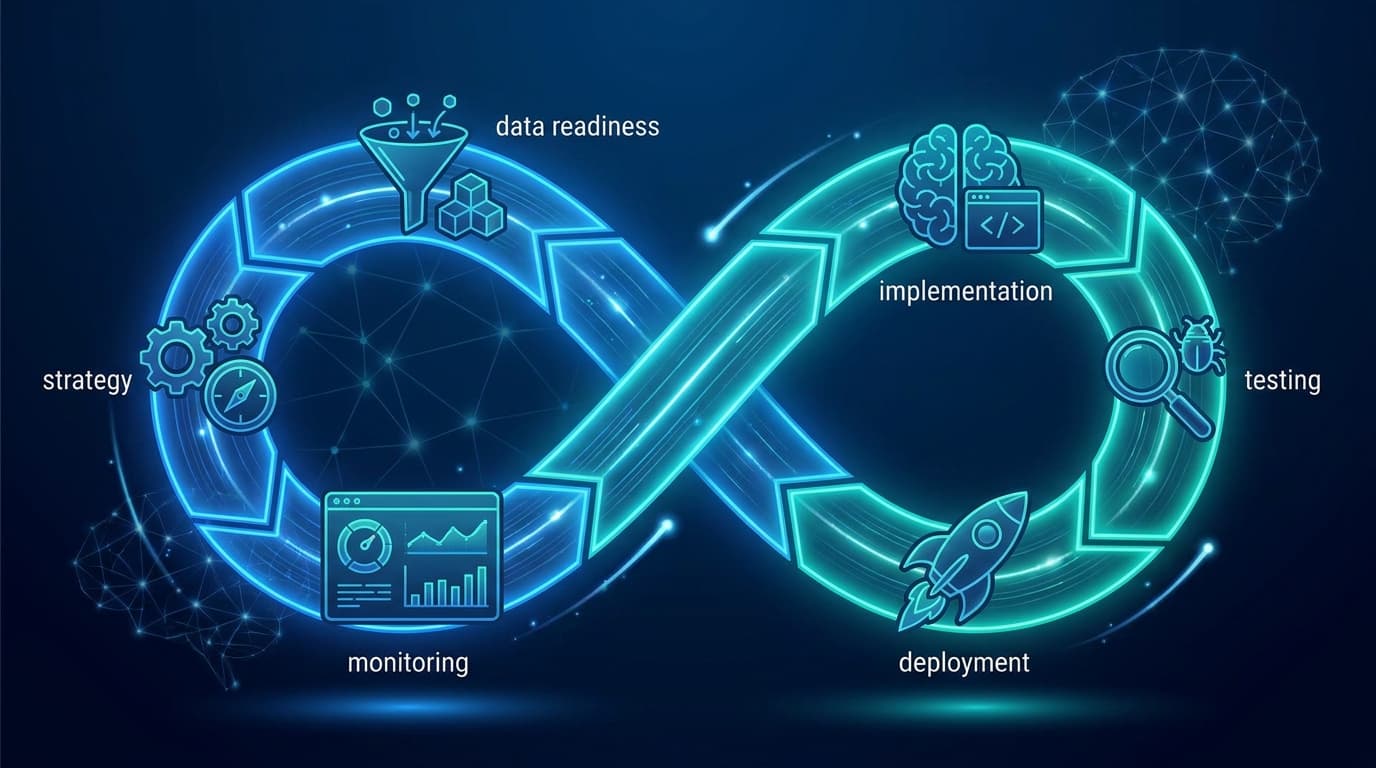
A well-managed AI initiative should move through connected stages. Weakness in one stage creates problems in the next.
1) Strategy and use case definition
Before selecting a model or building a workflow, define:
- What problem is being solved
- Why the problem matters commercially
- Which team or process improves
- What success looks like
- What risks or constraints must be respected
If this stage is weak, the project becomes harder to steer later.
2) Data and workflow readiness
This is where many AI projects become unstable.
A strong idea is not enough if data is fragmented, low quality, inaccessible, or disconnected from the real workflow.
Assess:
- Data quality and availability
- Access controls and permissions
- System dependencies
- Integration requirements
- Context requirements for AI workflows
In Agentic AI project management, workflow readiness matters as much as data readiness. Agents need clear inputs, boundaries, and a reliable operating environment.
3) Design and implementation
This is where workflow architecture takes shape.
Prompts, models, orchestration, integrations, approval logic, user experience, and failure handling all need deliberate design.
Optimise for more than capability. Optimise for:
- Reliability
- Observability
- Security
- Human oversight
- Maintainability
A fast build is not automatically a strong build.
4) Testing and evaluation
The question is not whether the system works in a demo. The question is whether it performs reliably under real conditions.
Evaluate:
- Output quality
- Failure cases
- Response consistency
- Escalation behaviour
- Cost and latency
- Workflow impact
- Compliance and policy risk
This matters even more in Agentic AI systems, where actions can carry higher operational consequences.
5) Deployment and adoption
Going live is not the end. It is the start of operational reality.
A strong deployment phase includes:
- Clear ownership
- Team enablement
- Internal documentation
- Defined escalation paths
- Live performance visibility
- Communication around rollout expectations
If adoption is weak, even technically capable AI can fail commercially.
6) Monitoring and iteration
Every AI system changes in production.
User behaviour shifts. Processes evolve. Data quality changes. Performance drifts. New risks appear.
That is why managing AI project lifecycles must include continuous monitoring and structured iteration.
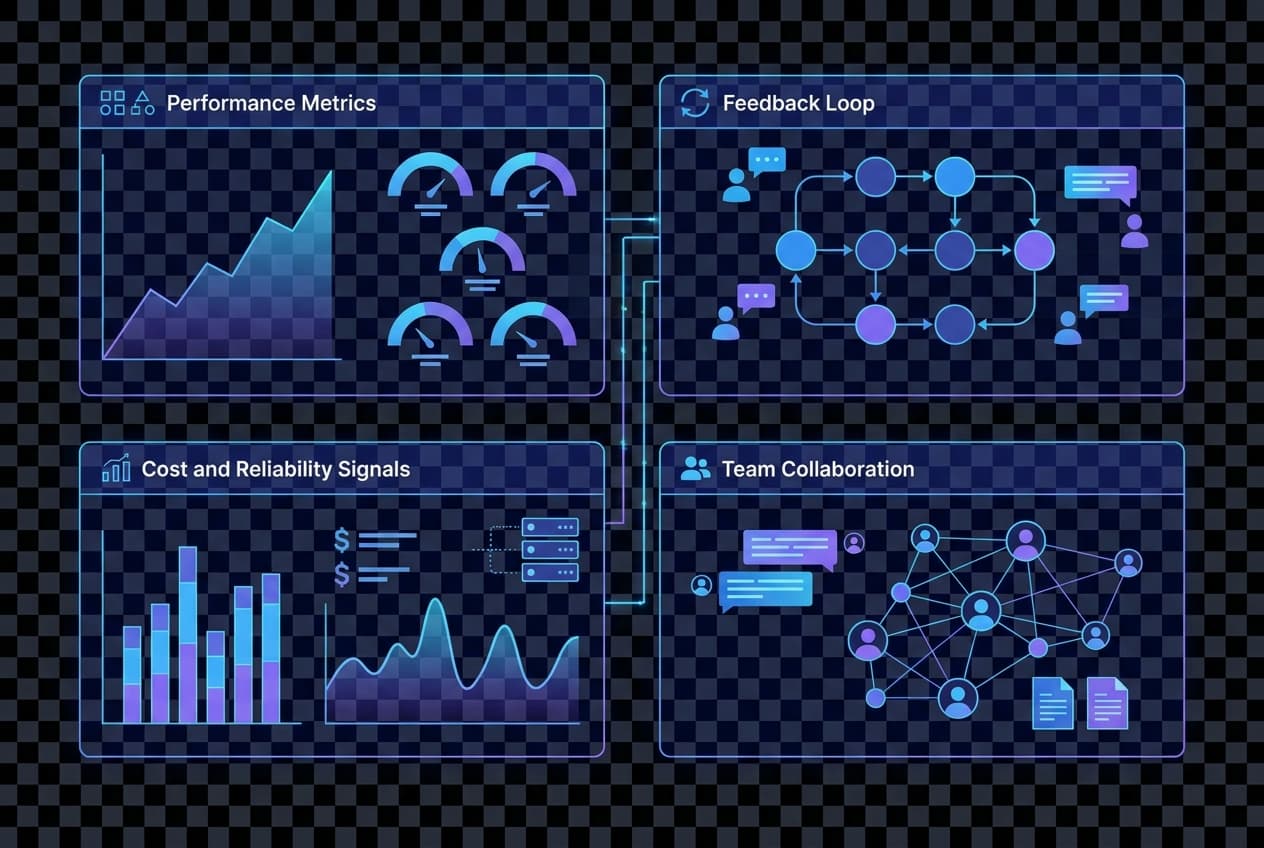
Track:
- Performance against business goals
- Failure patterns
- Workflow friction
- User trust
- Cost efficiency
- New improvement opportunities
The strongest AI systems are not static. They improve through disciplined iteration.
How Agentic AI Raises the Lifecycle Standard
Traditional AI projects already need strong oversight.
Agentic AI project lifecycles raise the standard further.
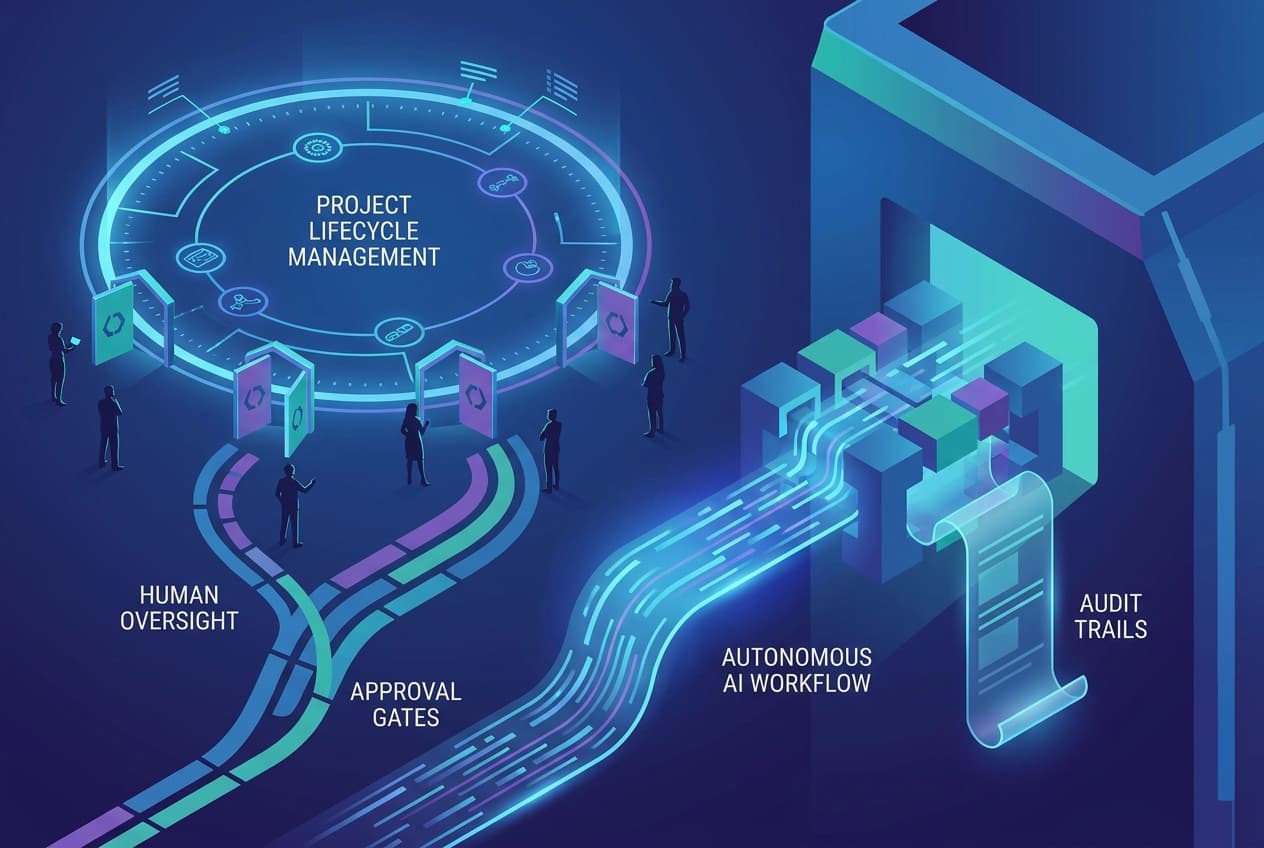
When systems can reason across steps, call tools, trigger actions, or coordinate multi-stage workflows, lifecycle management becomes more operationally critical.
Businesses need to define:
- What the agent is allowed to do
- When human approval is required
- How actions are logged and reviewed
- How exceptions are escalated
- How failure states are contained
- How accountability is maintained
This is why Agentic AI cannot be managed like a basic automation script. It requires structured governance from design through ongoing operations.
AI Project Lifecycle Management Checklist
Use this checklist to pressure-test your initiative before and after launch:
- Business outcome is explicit and measurable
- Workflow design is mapped end to end
- Data quality and access controls are validated
- Human approvals and escalation paths are defined
- Reliability, cost, and risk metrics are tracked
- Ownership is assigned for operations, not just build
- Post-launch review cadence is scheduled
If two or more of these are unclear, the lifecycle is probably under-designed.
Common Mistakes Businesses Make
Even strong teams fall into predictable traps:
- Treating pilot success as proof of production readiness
- Underestimating integration complexity
- Skipping structured evaluation
- Launching without change management
- Ignoring post-launch monitoring
- Assuming AI can operate without clear ownership
These mistakes are expensive because they usually surface after time, budget, and internal confidence are already invested.
FAQs About AI Project Lifecycle Management
What is AI project lifecycle management?
AI project lifecycle management is the process of taking an AI initiative from strategy and planning through design, implementation, testing, deployment, monitoring, and continuous optimisation.
Why do AI projects fail after promising pilots?
Many pilots succeed in controlled settings but fail in production because workflow design, governance, ownership, and adoption planning were not strong enough.
How is managing an Agentic AI project different?
Agentic AI projects involve more autonomy and operational risk. They require stronger governance, clearer boundaries, better observability, and deliberate human oversight.
What should businesses measure in an AI project?
Measure business impact, output quality, workflow efficiency, adoption, reliability, cost, and trust, not just model-level accuracy.
What is the fastest way to improve AI lifecycle performance?
Start by tightening ownership, governance, and post-launch monitoring. Most failures come from weak operations, not weak model choice.
Conclusion
Effectively managing AI project lifecycles is what separates impressive demos from durable business value.
The businesses that get the most from AI will not be the ones running the most experiments. They will be the ones managing AI with discipline, clarity, and operational accountability.
At Akonita, we help businesses design and run Agentic AI project lifecycles with stronger structure, sharper governance, and clearer business outcomes.
If you want to implement a practical AI lifecycle strategy in your organisation, talk to us here: https://akonita.com/contact.