
AI for Sales Teams: Qualify Leads and Close Faster

TL;DR: Sales AI in 2026 is not a robot making cold calls. It is a set of systems that handle the invisible work — lead research, qualification scoring, CRM enrichment, follow-up sequencing, and pipeline hygiene — freeing reps to spend more time on conversations that close deals. The teams winning with AI are not cutting headcount. They are giving every rep the leverage that used to require an assistant, a data analyst, and a photographic memory for every deal in the pipeline.
Introduction
The average sales representative in 2026 spends roughly 60 percent of their working week on tasks that do not involve selling. Researching prospects. Updating CRM records. Writing follow-up emails. Qualifying inbound leads that turn out to be a poor fit. Chasing internal approvals for proposals and quotes. These are not unimportant tasks — they are necessary. But they are also predictable, repeatable, and increasingly automatable.
The sales organisations pulling ahead right now are not the ones with the largest teams or the most aggressive quotas. They are the ones that have systematically removed the friction between a rep and their next meaningful conversation. And the tool they are using to do it is AI — not as a replacement for salespeople, but as a force multiplier that handles the administrative load and surfaces the signals a human would miss.
This article maps out where AI fits in the modern sales workflow, what it can and cannot do, and how to get your reps to actually use it.
Where AI fits in the sales workflow
Sales is a chain of activities from first contact to closed deal. AI fits at specific points in that chain — not everywhere, and not all at once. The highest-impact insertion points are the ones where the work is high-volume, pattern-based, and currently done by reps who would rather be selling.
Prospecting and research
Before a rep writes a single line of outreach, they need to understand who they are reaching out to. What industry is the prospect in? What recent funding, leadership changes, or strategic announcements might signal readiness? What problems does their role typically face that your product solves?
AI handles this pre-call research in minutes instead of hours. It aggregates publicly available information — company news, earnings calls, job postings, social signals — and produces a concise brief tailored to the specific prospect and the specific offering. The rep arrives at the conversation already informed. The prospect feels understood, not prospected.
Lead qualification and scoring
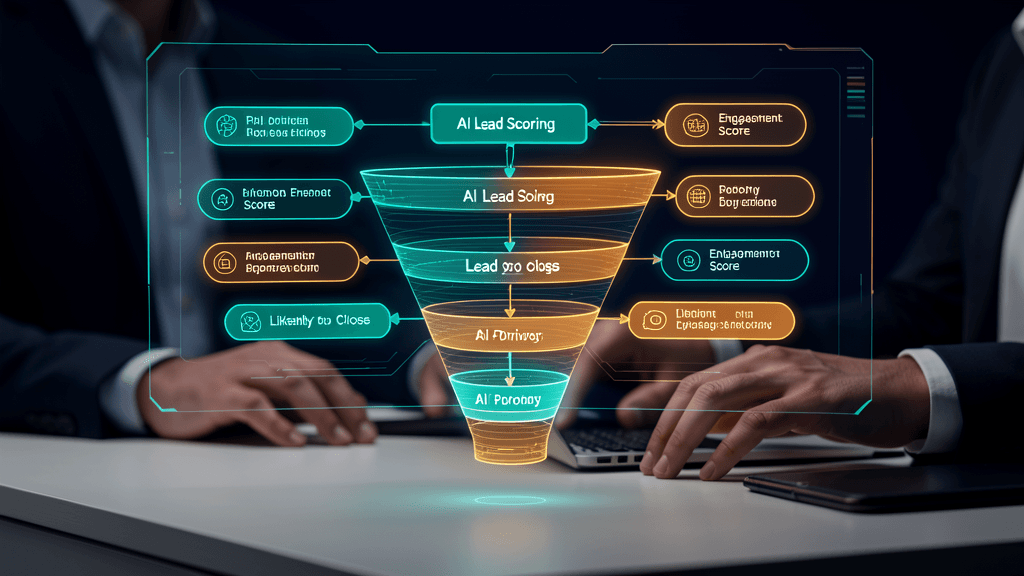
Not every lead deserves a rep's time — and the ones that do are not always obvious. Traditional lead scoring relies on demographic fit and basic engagement signals: job title, company size, email opened, whitepaper downloaded. AI adds behavioural depth.
It analyses communication patterns across channels — email threads, meeting transcripts, support tickets, website visits — and identifies signals of genuine intent that static scoring misses. A lead that has visited the pricing page three times in two days, cross-referenced against a competitor comparison page, and come from a company that matches your ideal customer profile in revenue, industry, and tech stack is a hotter signal than any form fill. AI surfaces these patterns in real time so reps focus on the leads most likely to close.
Outreach sequencing
The difference between a generic outreach sequence and an effective one is personalisation — and personalisation takes time. AI can draft context-aware outreach emails that reference the prospect's industry, role, recent company events, and specific pain points. It can adjust tone and length based on what has worked with similar profiles in the past. And it can manage follow-up cadence so that no conversation goes cold without a deliberate decision to let it.
This is not about sending AI-generated spam. It is about giving every rep a starting point that is already 80 percent personalised — so they spend their time on the 20 percent that requires human judgment and relationship awareness.
CRM enrichment and pipeline hygiene
The universal complaint about CRM systems is that they are only as good as the data people put into them — and people are inconsistent. AI solves this by continuously enriching CRM records with external data and by surfacing what is missing, outdated, or contradictory.
It flags contacts that have changed roles. It populates missing firmographic data. It identifies deals that have stalled based on activity patterns — no email in three weeks, no meeting scheduled, no next step logged. These are not disciplinary nudges. They are helpful reminders that prevent pipeline rot and give sales managers visibility without the weekly spreadsheet interrogation.
Proposal and quote generation
For many sales organisations, the period between verbal agreement and signed contract is where deals slow down. Proposals need to be written, pricing needs to be approved, scope needs to be documented. AI accelerates this by generating proposal drafts, quote configurations, and scope documents based on deal parameters and precedent — reducing the turnaround from days to hours, and sometimes to minutes.
The AI does not replace the rep's judgment about what to offer or at what price. It replaces the administrative work of assembling the documents and checking for consistency — the part that adds no strategic value but consumes real time.
What AI cannot do in sales
Understanding the limits is as important as understanding the capabilities. Overestimating AI leads to poorly designed workflows and disappointed teams. The most important things to understand are the boundaries.
AI cannot build trust. Trust is earned through reliability, empathy, and shared context over time. AI can surface the information that helps a rep earn trust faster — it cannot earn trust on its own.
AI cannot handle novel objections. A trained AI can suggest responses to common objections based on historical patterns. It cannot improvise in the face of a genuinely new concern from a prospect in a complex deal, because it has no model of the specific relationship, the political dynamics, or the unstated motivations in the room.
AI cannot read the room. Tone, body language, hesitation, excitement — the signals that tell an experienced rep when to push and when to pause — are not accessible to an AI system reading a transcript. These signals matter most in the deals that matter most.
AI cannot be accountable. If a deal goes wrong, someone needs to own it. A rep who says "the AI told me to" has not answered the question. Accountability lives with the person, not the system — which means the person must be the decision-maker, not the order-taker for an AI recommendation.
The practical rule: AI should handle what is repetitive, research-intensive, and administrative. Humans should handle what is novel, relational, and high-stakes. The sweet spot is the overlap — where AI gives the human better information faster, and the human makes better decisions as a result.

Getting rep buy-in
The best AI sales tool in the world is worthless if the team refuses to use it. Adoption is not a technology problem — it is a change management problem, and it follows predictable patterns.
Start with the pain, not the tool
No rep wakes up excited about a new software rollout. They wake up annoyed that they spent two hours updating CRM records instead of making calls, or frustrated that they missed a follow-up on a deal that was ready to close. Start the conversation there — with the specific, named frustration that AI can reduce — not with a demo of the tool. When reps see AI as a solution to a problem they already feel, adoption is voluntary. When they see it as another mandate from leadership, it is not.
Involve reps in the design
The people who will use the AI system should have a voice in how it works. What follows-up sequence timing makes sense for their territory? Which qualification signals actually matter in their experience? What CRM fields do they actually use versus the ones that exist only for reporting? When reps help define the rules the AI follows, they are more likely to trust the outputs — and more willing to flag when something is off.
Make the value visible in week one
The fastest way to build adoption is to show a rep something useful they did not have before — and to show it in the first week. An AI-generated prospect brief that saves 45 minutes of research. A pipeline alert that surfaces a stalled deal before the rep realises it has gone cold. A follow-up draft that is good enough to edit, not write from scratch. Early wins are more persuasive than any training session.
Set the expectation: AI is an assistant, not a replacement
This needs to be said explicitly and repeatedly — especially in sales organisations where headcount anxiety is real. If reps suspect the AI is being built to reduce the team, they will not help you build it. They will quietly undermine it. The framing that works: "This system is designed to give you back the hours you currently spend on research, data entry, and admin — so you can spend them on conversations that close." When the message is consistent and the behaviour matches it, resistance drops.

The implementation sequence that works
Sales AI projects fail most often not because the technology is wrong, but because the rollout is too ambitious. Organisations that succeed follow a deliberate sequence.
Phase 1: Pick one workflow and make it great. Start with lead qualification, CRM enrichment, or follow-up sequencing — not all three. Get one workflow working reliably with a small group of reps. Measure the time saved, the pipeline improvement, the adoption rate. Fix what is not working before expanding.
Phase 2: Expand to adjacent workflows with the same group. Once the first workflow is trusted and adopted, add the next one. The same reps who have learned to trust the system in one area are more willing to try it in another. This is faster and cheaper than trying to roll out to a larger group from scratch.
Phase 3: Scale across the team. Only after two workflows are stable and adopted with the pilot group do you roll out to the full sales organisation. By this point, you have internal champions, documented best practices, and evidence of value — all of which make adoption smoother.
The temptation to skip this sequence is strong. "We know what we want to build, let us just build it all and roll it out." Organisations that give in to that temptation typically spend six months building a system that nobody uses, then another six months trying to figure out why.
FAQs: AI for Sales Teams
Will AI replace sales development representatives?
Not in the near term — but it will change what the role demands. AI handles the repetitive research and outreach at scale, which means SDRs who relied on volume alone will struggle. SDRs who can use AI to identify higher-quality prospects, personalise outreach more effectively, and spend more time on genuine conversations will become more valuable. The role shifts from activity volume to conversation quality.
How accurate is AI lead scoring compared to traditional scoring?
AI lead scoring typically outperforms static rules-based scoring because it incorporates behavioural signals that static models miss — patterns in communication timing, content engagement depth, and cross-channel activity. However, accuracy depends on data quality and model training. An AI scoring model trained on incomplete or biased historical data will reproduce those gaps. The implementation should include a calibration period where human judgment validates the AI's recommendations, and the model improves from that feedback.
What does it cost to implement AI for a sales team?
Cost varies by scope, integration complexity, and whether you build custom or use an off-the-shelf solution. A focused AI tool handling a single workflow — lead scoring, for example — can be deployed for $20,000 to $50,000. A comprehensive system covering multiple workflows with CRM integration, custom models, and ongoing monitoring typically ranges from $80,000 to $200,000 in year one. The more useful question is what the current cost of the problem is: how many rep-hours are lost to administrative work per week, and what is the value of the deals that go cold because follow-up fell through the cracks.
How long does implementation take?
A focused single-workflow deployment with an experienced partner can go from scoping to production in four to eight weeks. A multi-workflow rollout across a full sales organisation typically takes three to six months when done in phases. The timeline is driven less by the technology build and more by the integration work, the data preparation, and the change management — categories that account for more of the elapsed time than most teams expect.
Does this work with our existing CRM?
Almost certainly yes — but the integration quality determines the outcome. If your CRM data is clean and well-structured, AI can enrich and act on it effectively. If your CRM is a graveyard of outdated contacts, duplicate records, and incomplete deal stages, the AI will surface the mess rather than fix it. A CRM data cleanup is often the most valuable first step in an AI sales project — and the one teams are most tempted to skip.
How do we measure whether it is working?
Track three categories. Efficiency metrics: time saved per rep on research, data entry, and follow-up administration. Pipeline metrics: lead-to-opportunity conversion rate, average deal velocity, percentage of deals with documented next steps. Adoption metrics: percentage of reps using the system daily, percentage of AI-generated suggestions accepted versus overridden. If efficiency and pipeline metrics improve but adoption is low, the system is probably doing something the team does not trust. If adoption is high but pipeline metrics are flat, the system is saving time but not improving outcomes — which means the time saved is not being reinvested into higher-value activities.
Conclusion
The sales organisations winning in 2026 are not the ones waiting for AI to replace their teams. They are the ones using AI to make every rep more capable — giving them better information faster, removing the administrative friction that consumes half the working week, and surfacing the signals that separate real opportunities from distractions.
This is not a technology project with a finish line. It is an operating model shift that, done well, compounds over time. The teams that integrate AI thoughtfully — starting small, involving their reps in the design, measuring what matters — build a capability gap that widens every quarter. The teams that treat it as a tool to cut costs find themselves with a tool nobody uses and a cost they cannot justify.
At Akonita, we help sales organisations design and deploy AI systems that make every rep more effective — starting with the specific workflow that will deliver the fastest measurable impact. If you want to see what that looks like for your sales team, let us map it out together.
Map your sales AI workflow with us — we will help you identify the highest-impact starting point and build from there.