
AI for Healthcare & Clinics: The Playbook

This is part of our AI by Industry playbook series — practical guides for operators, not trend forecasts. If you run a practice with compliance obligations closer to banking than retail, start with the financial services playbook.
Ask a clinic administrator where the pain is and you won't hear about diagnostics. You'll hear about the phone. The voicemail inbox. The intake forms retyped into an EHR by hand. The prior authorization that bounced twice. The same twelve questions the front desk answers every day, every patient, in between checking people in.
That's the honest picture of where healthcare AI stands today: the fastest wins are administrative, and they're available right now. The clinical layer — triage support, imaging assistance, ambient documentation — is real but uneven, and it comes with a compliance architecture you can't skip. This playbook covers both layers honestly: what to automate first, what data each workflow needs, what it costs, and where AI must never go.
Start with the front desk, not the exam room
Healthcare operators often start their AI thinking at the most glamorous end — clinical decision support, diagnostic models, the things that sound like the future. That's backwards. The exam room has a clinician in it who went to school for a decade, and the economics of automating their judgment are slow, regulated, and unforgiving.
The front desk has no such problem. Industry surveys consistently estimate that clinic staff spend a third to half of their time on administrative work — scheduling, intake, billing queries, message triage, insurance verification. That's where your data already exists, your workflows are already documented, and an error is recoverable rather than dangerous.

The same decision inventory exercise we use in every playbook in this series, adapted for a clinic: for two weeks, log every patient interaction and document flow. Appointment requests, reschedules, intake forms, prescription refill requests, billing questions, insurance disputes, no-shows, recalls. For each, note volume, handling time, error rate, and whether a human must sign off before anything touches a patient record.
The five administrative workflows that pay first
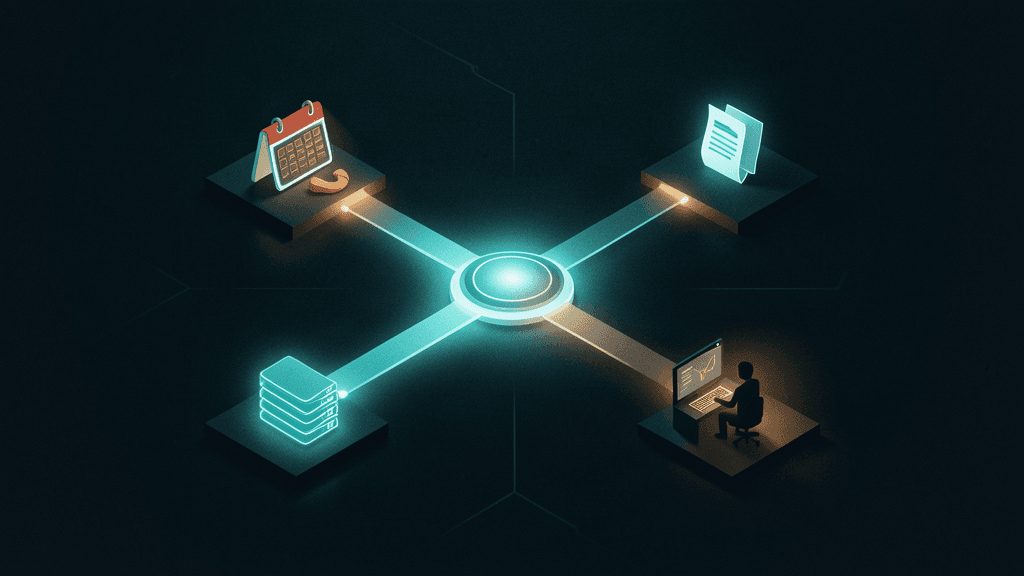
Patient scheduling and intake. The classic first win. An AI concierge answers scheduling questions, books and reschedules against your actual calendar, sends intake forms, and chases incomplete ones. The data requirement is modest — your scheduling system, your form templates, and a well-tested escalation path to a human. Clinics typically see front-desk phone load drop by 30–50% here, which is capacity returned to the people standing at the desk.
Phone and message triage. Most patient messages are routine: refills, directions, records requests, portal password resets, "what do I do about this mild symptom" questions. An AI triage layer answers the routine ones directly, drafts responses to the clinical ones for staff review, and routes anything urgent immediately. The routing rule matters more than the model: anything touching clinical judgment gets a human, always.
Billing and claims follow-up. Denied claims, missing prior authorizations, unpaid balances — this is high-volume, rules-heavy work that AI handles well. Automated follow-up sequences on claim status, extraction of explanation-of-benefits data, and flagged anomalies for staff review. This workflow pays for itself quietly because it converts into revenue recovery rather than just cost savings.
No-show prediction and recall. Your scheduling history already contains the signal: which appointment types no-show, at which times, for which patient segments. A model trained on that history can trigger targeted reminders or overbooking policies where the data justifies them. This is the workflow in the whole playbook that requires the least new infrastructure — the data exists, it's just never been read.
Records and document handling. Referral letters, lab results, faxed documents — healthcare runs on documents in formats that resist structure. Extraction and routing models clean this up before it reaches staff, which cuts the retyping work that quietly consumes hours a day.
The clinical layer: what's real, what's emerging
Now the part most articles skip: the frontier is genuinely moving into clinical territory, and pretending otherwise would make this playbook useless in two years. But the maturity varies enormously by workflow.
Ambient documentation (AI scribes) is the strongest clinical-adjacent win today. Tools that listen to the consultation and draft the clinical note are deployed at scale in practices now, and the value is measured in clinician hours — documentation is consistently one of the largest time sinks in clinical work. The human reviews and signs the note; the AI removes the blank-page problem.
Imaging assistance is real and regulatory-approved in specific, narrow applications — flagging findings for radiologist review, prioritizing worklists, measuring what humans already measure. The operative word is assistance: the radiologist remains the decision-maker. What's still research is anything that replaces the read.
Triage prioritization — deciding which patient in the queue is seen first — exists in production in emergency settings, but always as a recommendation layer that clinicians can and do override. Treatment planning and diagnostic support are the least mature; treat anything marketed as autonomous decision-making here as a red flag, not a feature.
The honest framing for a clinic operator: the clinical layer is worth piloting where a specific vendor has regulatory clearance and a documented evidence base. It's not worth building your AI strategy around yet.
Where AI must never go
Three hard boundaries, and they're not negotiable:
- Diagnosis and treatment decisions. AI can surface information and flag patterns. A licensed clinician decides. Full stop.
- Unreviewed clinical communication. Anything a patient reads that could be interpreted as medical advice goes through human review.
- Raw patient data in general-purpose models. Patient identifiers, clinical records, and anything that constitutes protected health information stay inside a controlled environment — never pasted into a public AI tool, never sent to a model without a business-associate agreement and data residency guarantees.
That last boundary is where most clinic AI disasters actually happen, and they happen at the staff level, not the vendor level — a well-meaning employee summarizing a patient note in a chatbot window. Your compliance architecture has to assume that failure mode and design it out.
The compliance architecture
Healthcare isn't the only regulated industry in this series, but it has the least tolerance for getting data boundaries wrong. The architecture that lets AI ship in a clinic is well understood:
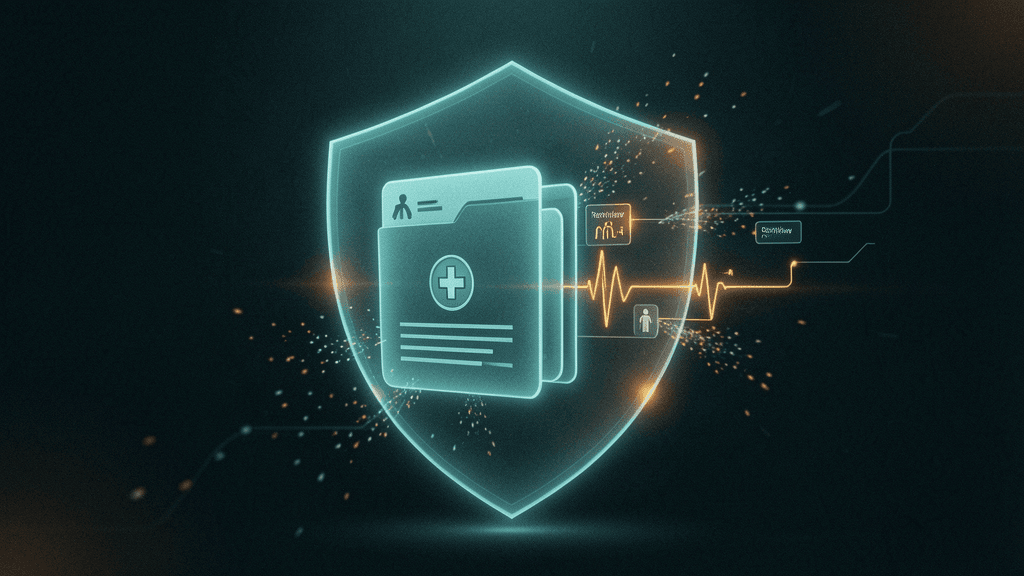
Data residency and agreements first. Every vendor that touches patient data needs a business-associate agreement (or your jurisdiction's equivalent), documented data residency, and an audit trail of what the system accessed. If a vendor can't produce these, the conversation ends there — no matter how good the demo was.
Separate environments. Administrative AI (scheduling, billing, FAQ) runs on operational data with lighter sensitivity. Anything clinical runs in a controlled environment with PHI access restricted, logged, and minimized. The two never share a data path.
Human checkpoints at clinical boundaries. Every workflow touching clinical content has a named human role that reviews and approves. This isn't bureaucratic caution — it's how you keep the system auditable and how you keep staff trust.
Auditability by default. Log what the AI answered, what it routed, what a human changed. When a compliance question arrives — and in healthcare it will — the answer is a query, not an investigation.
We cover the data-side architecture in more depth in Private by Design, and the human-oversight patterns in the human-in-the-loop blueprint.
Staff adoption: the workflow that decides everything else
Clinical environments run on trust and habit, and an AI tool that breaks either gets quietly abandoned no matter how good it is. The clinics that succeed with AI share a pattern: they start with one workflow the staff themselves complain about, they keep a human in the loop visibly, and they let the staff see the escalation path work before they're asked to rely on it.
Two practical rules. First, never introduce an AI tool during a staffing crunch — adoption requires attention, and attention is the thing a stretched practice doesn't have. Second, measure the front desk's reaction in week one, not month three. If staff are quietly routing around the tool, the workflow fit is wrong, and it's cheaper to fix in week one.
Timeline and cost for a mid-market clinic
A realistic picture for a multi-practice clinic or a mid-sized single site:
- Weeks 1–2: Decision inventory and data check. What systems exist, what APIs they expose, where the PHI boundaries sit.
- Weeks 3–8: First workflow — almost always scheduling, intake, or phone triage. Built in a controlled environment, escalated paths tested with real scenarios before going live.
- Weeks 9–12: Measurement and hardening. Handle rates, escalation accuracy, staff feedback. Fix the workflow fit before adding a second workflow.
- Month 4 onward: Second and third workflows, typically billing follow-up and no-show prediction. The clinical layer pilots start only after the administrative layer has earned staff trust.
Cost for the administrative layer at this scale typically lands in the low tens of thousands to build, with ongoing costs dominated by the AI usage itself — for a clinic, usually a few hundred dollars a month at realistic volumes. The clinical layer, where pursued via established vendors, is a licensing conversation with per-clinician pricing, not a build.
The bottom line
Healthcare AI in 2026 is not a clinical revolution story. It's an operations story: give the front desk its time back, stop the revenue leaking through billing follow-up gaps, and read the scheduling data you already have. Do that well, with a compliance architecture your staff can see working, and the clinical layer becomes a measured, informed pilot instead of a leap.
The clinics that get this right don't start with the most advanced AI. They start with the phone.
If your front desk is still answering the same twelve questions manually, that's the first conversation worth having. Talk to us about a patient-facing AI concierge — built inside your data boundaries, escalated to humans where it counts. Or see what your scheduling data is already hiding before you spend a dollar on anything clinical.