
Prompt Engineering Ops Kit - Ship-Ready Prompts at Scale

Shipping AI features isn’t just about clever wording — it’s about controlling every moving part from intent to monitoring. This kit expands on our From Prompt to Production article with the exact frameworks, checklists, and artifacts we deploy for clients who need reliability, compliance, and measurable ROI.
Use this kit when… you’re past the demo stage and need prompts that can survive stakeholder reviews, regression suites, and on-call rotations. Each section includes the artifacts you can lift directly into your repos or runbooks.
1. Production Prompt Anatomy
A production-grade prompt is explicit about four things:
- System Persona (Who?) — tone, permissions, risk posture.
- "You are an expert financial analyst. You communicate in concise, objective language and never offer speculative advice."
- Context (What?) — the curated facts, retrieved docs, or user state.
<input_data>[RAG documents + metadata]</input_data>
- Instructions (How?) — numbered reasoning steps (a built-in chain-of-thought scaffold).
- "1) Summarize the user issue in 2 sentences. 2) Ask for missing data if needed. 3) Provide the resolution strictly from context."
- Output Format (Shape?) — the schema or layout you expect.
- "Return JSON matching
{ "sentiment": "positive|neutral|negative", "confidence": 0.0-1.0 }. No markdown."
- "Return JSON matching
📎 Template: store each prompt as prompts/<domain>/<intent>/vX.Y.Z.json with the fields above. That file becomes the single source of truth for reviewers and tooling.
2. Versioning & Change Control
Treat prompts like any other surface that can break production.
- Semantic versioning communicates risk.
MAJORwhen the persona/model/format changes.MINORfor new few-shot exemplars or instructions.PATCHfor typo or tone tweaks.
- Decouple from code by referencing prompts through a registry, CMS, or signed bundle. Rollbacks become instant.
- Environment parity: Dev → Staging → Prod registries prevent “works on my laptop” surprises.
- Approvals: PRs on prompt files require design + engineering sign-off, not just the person who edited the text.
🛠️ Automation tip: lint prompts with a custom script that checks for required sections, banned phrases, and schema drift before CI green-lights a release.
3. Evaluation & Testing Framework
Before promoting a prompt, run it through this gauntlet:
- Golden dataset replay — 50–200 “greatest hits” inputs, including adversarial cases.
- LLM-as-a-judge scoring — a larger model grades tone, safety, task success.
- Latency + cost profile — track p90 + delta vs. previous version.
- Safety regression — jailbreak attempts, red-team strings, policy compliance.
- Schema adherence — 100 parallel calls that must parse without retries.
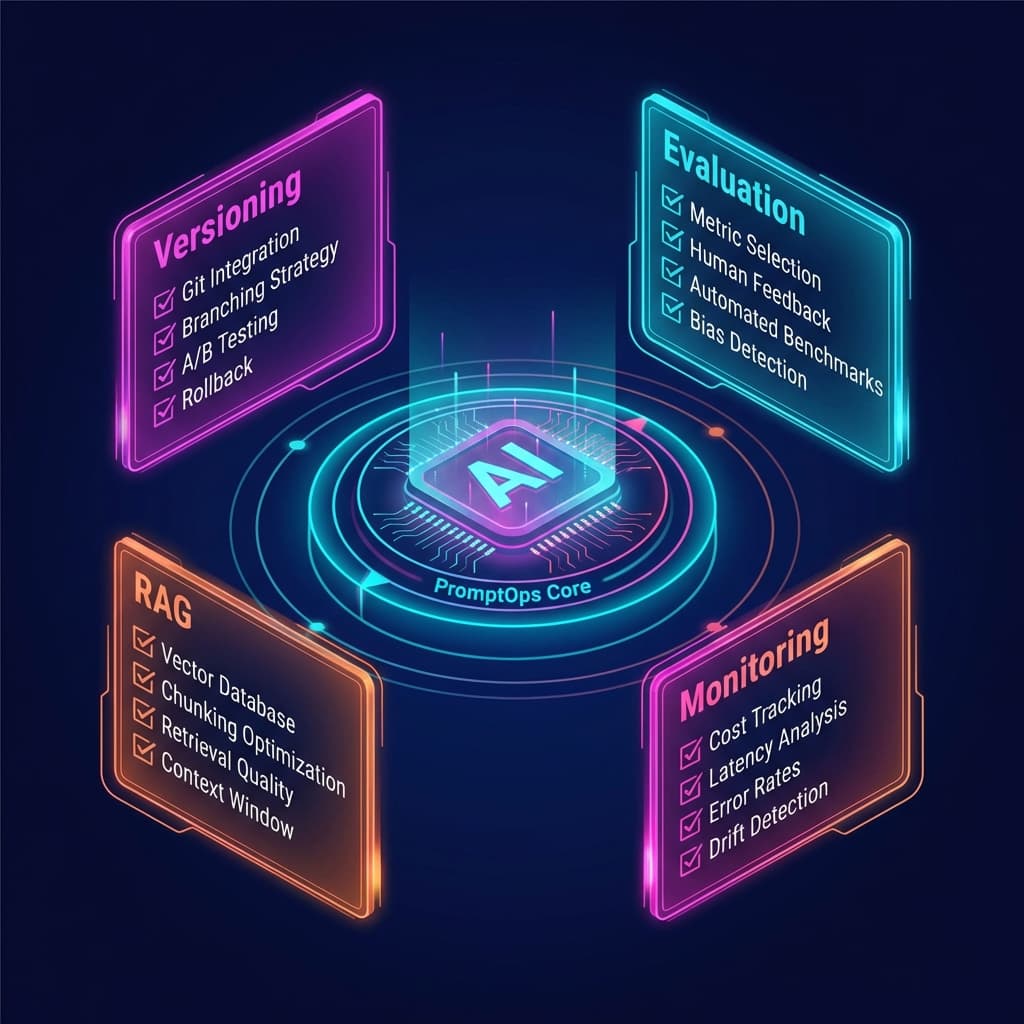
Store results next to the prompt version so audits show what changed and how it performed.
4. Advanced Few-Shot Strategy
Dynamic exemplars beat static snippets. Retrieve 3–5 semantically similar examples per request:
for query in prod_requests:
  neighbors = vector_store.similar(query, k=5)
  prompt.examples = neighbors[:3]  # freshest, most relevant context
- Maintain a library of
<input, ideal_output, notes>pairs for each intent. - Tag examples by sentiment, persona, and edge-case type so retrieval stays balanced.
- Rotate stale examples monthly to prevent model drift toward old language.
5. Context Limits & Token Budgets
- Budget by section: e.g., Persona 400, Context 2500, User 600, Reserve 1000.
- XML / JSON tags keep boundaries crisp:
<system_rules>Never reveal internal model names.</system_rules>
<background_docs>[RAG payload]</background_docs>
<user_query>{{ticket_body}}</user_query>
- Summarization chains: pre-compress long docs with a fast model before handing off to your premium model.
- Instruction sandwich: repeat the most critical guardrails at both the start and end of the prompt.
6. RAG Integration Playbook
- Semantic chunking with heading-aware splitters prevents half-sentences.
- Hybrid retrieval (vector + keyword) ensures SKU-level lookups still land.
- Cross-encoder re-ranking trims to the top 3–5 documents.
- Citations enforce provenance: "Latency improved 35% [doc_latency_12]".
- Freshness alerts catch outdated embeddings (e.g., if doc modified date is newer than index date).
7. Monitoring & Observability
Every prompt call should emit:
{
  "trace_id": "req_88492A",
  "prompt_version": "v1.2.0",
  "model": "gpt-4o-2024-05-13",
  "input_tokens": 1402,
  "output_tokens": 85,
  "latency_ms": 640,
  "user_feedback": "thumbs_up"
}
Track:
- Semantic drift (embedding centroid shift of incoming queries).
- Schema failure rate with PagerDuty hooks when >2% fail in 5 minutes.
- Cost per outcome — not cost per call — to justify optimizations.
- Human feedback loops wired back to the exact prompt + model build.
8. Ops Checklist (Copy/Paste)
| Track | Questions to Ask Weekly |
|---|---|
| Process | Are goals + guardrails documented per prompt? |
| Experimentation | Did we run A/B or champion/challenger tests this sprint? |
| Context Layer | Are embeddings fresh? Any stale docs flagged? |
| Versioning | Are prompt PRs reviewed + tagged with semantic versions? |
| Feedback | Did we review negative ratings + trace IDs? |
Quick yes/no sweep
- Traces, metrics, and structured logs live.
- Idempotent side effects for every tool call.
- Timeouts, retries, and circuit breakers tuned per workflow.
- Shadow/canary plan for every major prompt or model swap.
- Incident playbook includes human escalation + rollback steps.
Ready to Operationalize?
Managing prompts, context windows, and RAG pipelines at scale is equal parts engineering and product ops. If you need a partner to audit your current stack or build these workflows from scratch, we’d love to help.
Book a consultation with the Akonita AI Ops team and let’s turn your prototypes into bulletproof production systems.